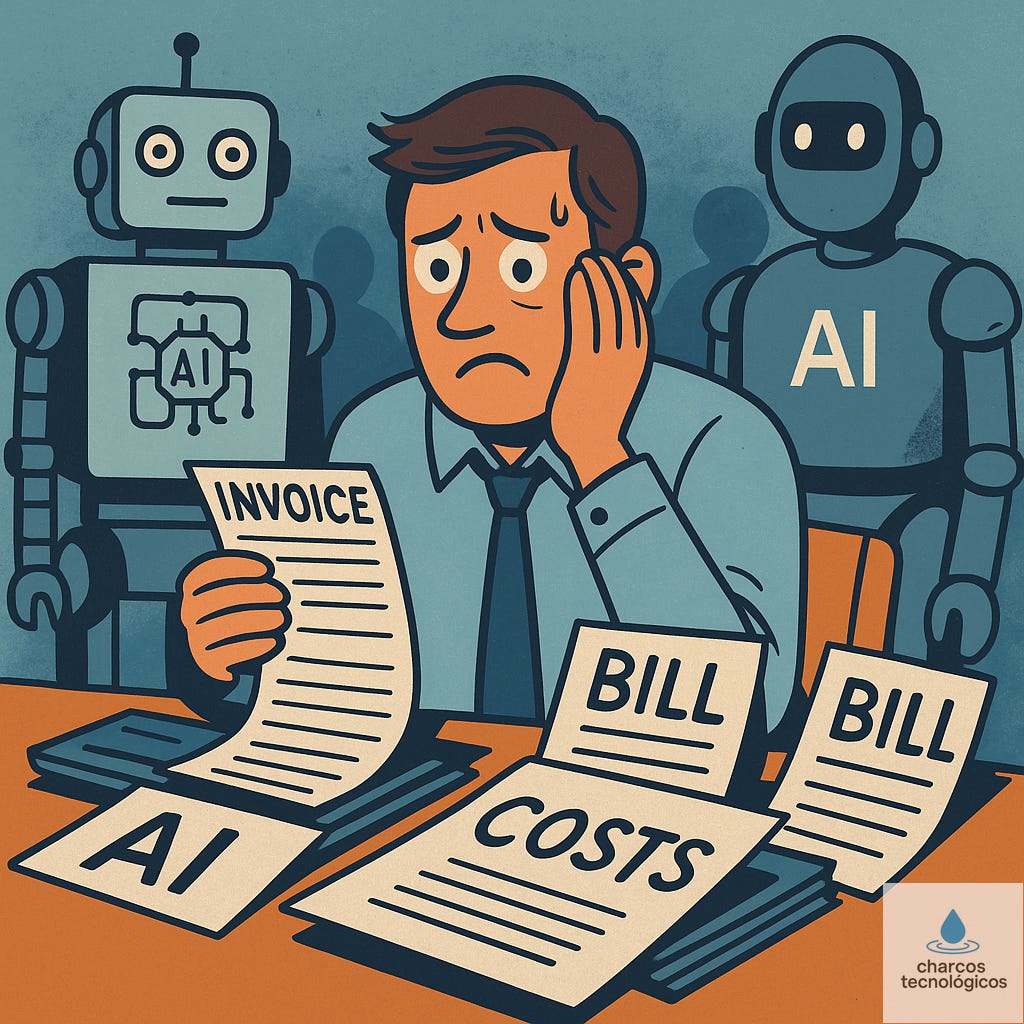
Image generated with ChatGPT
This is what Uncle Ben failed to warn Peter Parker about before he died. And it would have been very useful for him, because now he’s somewhat ruined after incorporating AI into all his gadgets.
It may seem silly, but this is what will happen to many companies if they get carried away by the siren songs of the usual snake oil salesmen. They will use the same old tactics: FOMO, training without foundation or utility, and, if they’re lucky, some European fund that allows them to continue deceiving the unsuspecting to fill their pockets.
🕒 Summary for busy people
Estimated reading time for the full article: 11 minutes.
AI is not a superpower: it’s a tool. And like any tool, it can save you time or ruin you if used indiscriminately. It’s more a matter of judgment than a technical one.
Many companies are falling into the same old trap: jumping on the hype train without knowing where it’s headed. They install expensive models for tasks that could be solved better with four lines of code or an Excel sheet. And when they discover the real cost, it’s already too late.
The key is not so much to ask what AI can do, but what sense it makes to use it here. If a series of simple rules suffice, use deterministic programming. If interpretation is needed, then use models.
Using AI well is not about dazzling, but about making decisions wisely. If you can’t measure its impact, cut it off in time. In this new gold rush, those who survive are not the fastest, but those who know when to stop.
Are you sure AI is necessary here?
We are getting used to everything having AI without asking ourselves if it is necessary or useful. It’s like when they wanted to replace all the databases in the world with blockchain. It didn’t matter that it was nonsense in terms of energy efficiency and performance. It was the trend, and everyone had to jump on the bandwagon.
Or like when all companies needed a community manager posting on all social media. Yes, even the corner bakery that functioned much better with handwritten signs and the word of mouth from Manolo and Toñi.
It’s not long before they start trying to sneak a prompt engineer into the few haberdasheries that still exist, lest they can’t classify all types of buttons and threads into neat taxonomies.
Why use AI? Here you depend on your judgment
💬 If a problem can be solved with fixed rules, use traditional programming. AI is not always better, just more expensive.
My heuristic rule is simple, and I will always repeat it: if a problem can be solved purely deterministically, prioritize traditional programming. You’ll avoid unnecessary complexities, high computational costs, and unpredictable outputs.
Calculating a tax or validating an email is better done with simple formulas than with a generative model.
However, the boundary is not binary: there are gray areas where AI offers advantages in efficiency or generalization—like optimizing routes with reinforcement learning or detecting financial patterns that are difficult to code by hand.
AI shines in non-deterministic or fuzzy problems when:
- The data requires contextual interpretation (natural language, sarcasm, nuances).
- It involves unstructured data (texts, images, recommendations).
- Or you need hybrid systems that combine rules and models to gain robustness.
Before deciding, evaluate the opportunity costs: Do you have sufficient and quality data? Does the problem tolerate approximations or biases? Is the extra cost of training and maintenance worth it?
With the rapid evolution of some models, AI is simplifying even “deterministic” tasks due to its generative capacity, but the key principle remains to use it when rules are costly or impossible to define exhaustively, always prioritizing simplicity and precision where feasible.
How to use AI? It’s time for experts
Okay, let’s assume you’ve passed the why filter and decided that yes, AI is not a whim but a real necessity. Now it’s time to define how to implement it without it backfiring and ending up with a set of cutting-edge tools but a hole in your accounting.
The trick is not to jump in recklessly with a model of 175 billion parameters just because it shines in comparisons. Start with the basics and then iterate to incorporate new functionalities with common sense. In enterprise software development, technological excellence is useless if it doesn’t drive business objectives.
Common sense decalog
1. Create a basic prototype and measure everything
Don’t buy a Ferrari to do your shopping at Mercadona. Create an MVP in an afternoon with Hugging Face or Jupyter Notebook and check:
- Does it optimize times? Remember that this can vary greatly from one sector to another. Optimizing 10% of very high-value tasks has more impact than tripling simple areas.
- Does it reduce human errors? If it increases or amplifies them, don’t continue down that path.
- Does it simplify maintenance? That’s where most money always goes.
If not, put it in the drawer.
2. Choose the model like you would choose a wine: by pairing and not by label
Not every problem needs the most powerful model. I have some projects where I use the most basic model available because no more complexity or brute force is needed. And if you’re looking to save, at least in the testing phase, consider open-source options.
3. Don’t replace: Integrate
AI is not a magician that does everything by itself. It’s more like a clumsy assistant that needs rules to avoid messing things up. Use hybrids: traditional programming for the predictable and AI for what escapes. In marketing, for example, let it generate copy ideas, and have a human remove the robotic touch that is becoming increasingly obvious.
4. Measure ROI as if your life depended on it, because your budget does
Calculate not only the savings in hours but also the hidden costs: servers that suck power like a starving vampire, data that needs cleaning (never trust blindly, especially in critical tasks), iterations that end in dead ends, and new situations whose impact you can’t measure a priori.
5. Train your team without falling into academic FOMO
We’ll leave it at five because a complete decalog is too much for a Saturday.
You don’t need to know everything at the beginning. Sometimes a practical workshop is enough to start getting into the material, although it all depends on the needs of each project. Here, more than ever, it’s necessary to foster (and truly support, not just in words) a culture of “trial and error.” If something fails, try to extract a valid lesson and keep improving. The key is to shorten cycles so that mistakes are small, cheap, and early.
In the end, using AI well in business processes is something relatively new that requires attention, a cool head, and control. If you do it right, you will not only avoid ending up like Spiderman, ruined by the hype, but you will also have more time to think and truly innovate.
We also have examples of misuse, like the case of Klarna, which laid off 700 employees in favor of an AI chatbot to “save” costs and ended up with more complaints than Renfe’s website during holidays. Of course, within a year they reversed course because their reputation was going down the drain.
How not to blow your budget (even if you use AI)
If you are clear on the “why” and the “how,” now comes the boring but vital part: not letting it drain your balance.
Use caches even if they’re not perfect
Every call to a model costs, and many are repetitive. Store the most frequent responses (for example, summaries, classifications, or generated texts) and reuse them. Sometimes, a simple Redis or SQLite can save you hundreds of euros a month.
No sophistication is needed: if a prompt and its response don’t change, save them. It’s like not asking the waiter for another round if you still have half a glass.
Monitor your balance like it’s gasoline
All providers—OpenAI, Anthropic, Grok, Mistral, etc.—allow you to set spending limits, usage alerts, and consumption dashboards. Use them. There’s nothing sadder than discovering you’ve blown your monthly budget on a Tuesday at 10 a.m. because your chatbot started philosophizing with a user.
Set up automatic alerts for usage, and if you can, integrate webhooks that cut calls when you exceed a certain threshold. Sometimes, the best optimization is the “emergency shutdown.”
Monitor and log every call.
You don’t need anything particularly complex. Just save timestamp, usuario, prompt, tokens, and coste estimado. Tools like LangFuse, Helicone, or OpenDevin Logs do it for you with included visualizations.
If an endpoint starts to spike, you’ll see it right away. In AI, the difference between control and ruin is often a well-made CSV.
Use local models when you can
Not all projects need the power (or price) of GPT-4. Open-source models like Mistral, Llama 3, Gemma, or Phi 3 work wonderfully if you tune them well.
A modest server with a decent GPU or even a rented instance by the hour can execute responses in milliseconds.
And if you’re worried about performance, try quantization (int4, int8) or LoRA adapters to train without breaking the bank.
I’m going to make up a saying that Jason Fried and David Heinemeier Hansson from 37Signals could have coined: “If you can serve it from home, don’t pay for every token.”
Curb infinite creativity
Limit the length, temperature, and frequency of your responses. Sometimes you don’t need an essay, just a word. Every token counts, literally.
Reducing from 2,000 to 300 tokens per response can mean an 85% reduction in cost and time.
And along the way, the result will be more concrete and less prone to improvising poetry when you just wanted a JSON.
Automate alerts
A simple script that compares daily consumption against a threshold and sends you an email can work wonders.
If you use Prometheus or Grafana, monitor metrics like “tokens per user,” “cost per endpoint,” or “prompt repetition ratio.”
When the curve rises for no reason, you’ll know that someone—or something—has gone haywire.
Evaluate ROI with real data
It’s not enough to say “AI helps us.” Measure if it reduces time, improves accuracy, or generates revenue.
If you can’t prove it, cut to the chase. Reinvesting in simplification is better than insisting on complicating.
If Tony Stark doesn’t sponsor you, proceed with caution
The biggest risk of AI is not that it will take your job, but that your budget will get drained without you realizing it. And not out of malice, but out of ignorance and excessive enthusiasm.
We have been automating tasks for centuries, and almost always for the better. Just make sure you don’t lose control or the taste for the artisanal.
So before rushing to put AI into everything, ask yourself if the problem you have needs a model or a rule, a GPU or a notebook, a dataset or a good Excel sheet. The line between innovating and wasting is as thin as your budget margin.
💬 With great hype comes great spending. And there, even Uncle Ben can’t save you.