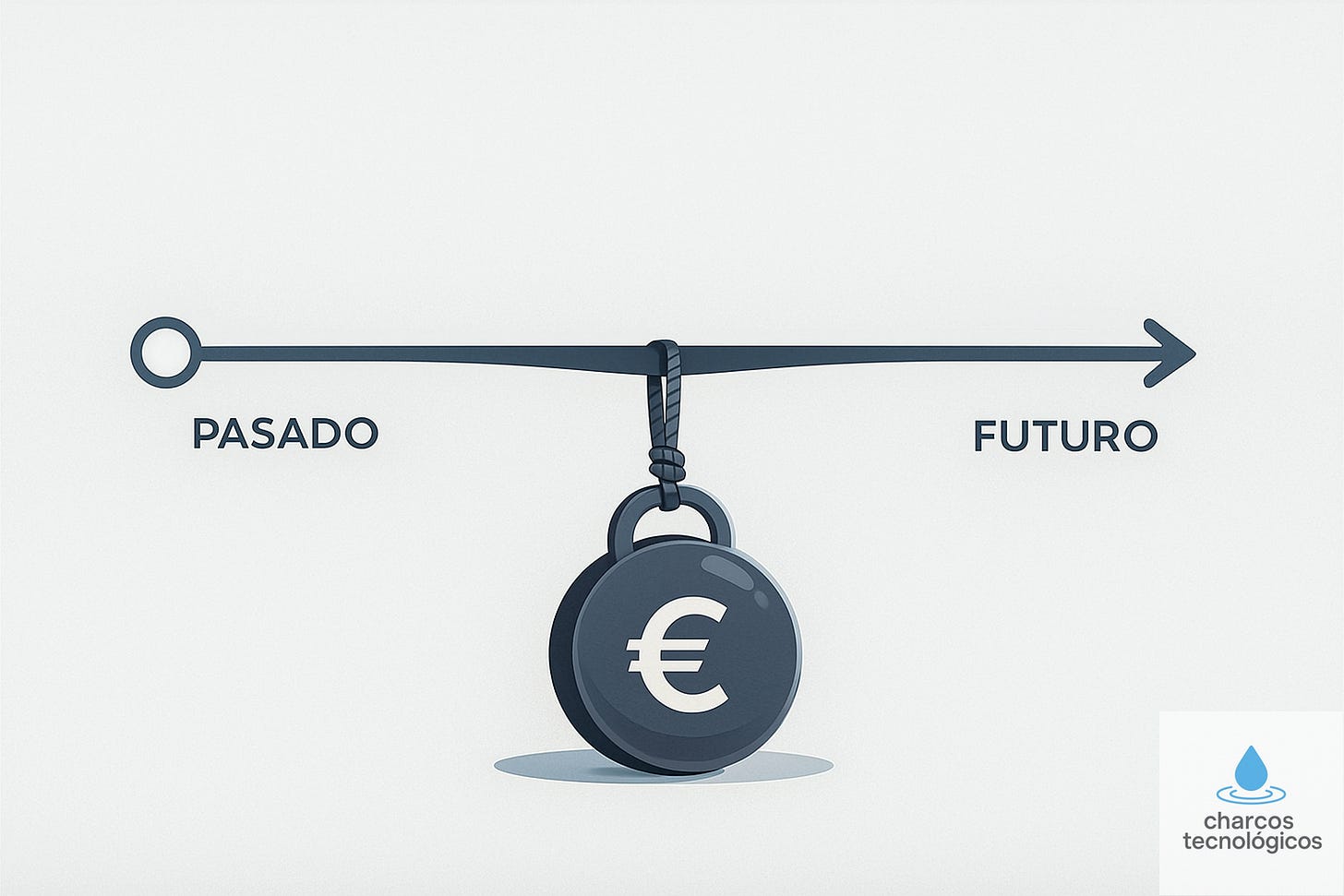
Image generated with ChatGPT. Years ago, I was torn between maintaining two businesses: FILHIN1, a wedding photography company, and Natiboo2, a software development firm. The former was becoming less profitable than the latter, but I was reluctant to close it. Not for strategic reasons, but out of attachment: we had invested a lot of money in equipment, branding, and materials. Then, my friend Samuel Guirado advised me that perhaps I shouldn’t consider that argument and spoke to me about something I was unaware of: the sunk cost fallacy.
🕒 Summary for Busy People
Estimated reading time for the full article: 9 minutes.
Sometimes we continue with projects that aren’t working because we don’t want to lose what it cost to get here.
The sunk cost fallacy makes us confuse perseverance with stubbornness. We insist on what no longer makes sense just to avoid feeling like we’ve lost.
The problem is that what’s lost is already lost. The only thing we can save is the time and resources we haven’t wasted yet.
Artificial intelligence can help us with that, not because it decides for us, but because it doesn’t carry emotions, pride, or fear of admitting mistakes. It shows us the data without the burden of history.
Letting go is not giving up. It’s choosing with our heads when memory pulls at our arms. Sometimes, the best investment is not to continue, but to know when to stop.
When the Mind Wants to Move Forward, but Memory Holds You Back
There are decisions made with memory, not with the mind. In the business and technology world, few things weigh as heavily as what we’ve already invested: hours, budgets, effort, prestige… All of that accumulates in an invisible backpack that becomes increasingly difficult to let go of.
And that’s where the sunk cost fallacy appears, that very human tendency to insist on projects that no longer make sense just because abandoning them would make us feel like we’ve lost.
The problem is that, in reality, we’ve already lost. The money, time, or energy invested is in the past; it won’t come back. The only thing at stake now is what we will continue to lose if we insist on looking back.
And we’re not just talking about money. We’re also talking about time. We all remember the threats received by the creators of Lost when the series ended. Many people, disappointed by the finale, accused them not so much for how they closed the story, but for the time they had invested in watching it. Perhaps they should have disconnected a few seasons earlier. But of course… they had already invested too much.
Looking at the Past as if It Were the Future
We all know when a project is dead. The hard part is saying it out loud.
When a project stalls, the rational thing would be to analyze whether it is still providing value, whether market conditions have changed, or whether there are better alternatives. However, many times the internal conversation revolves around a single idea: “We’ve already spent so much that we can’t stop now.”
That phrase is a clear symptom of the sunk cost fallacy: it doesn’t stem from analysis, but from the need to justify past decisions. No one likes to admit they were wrong, especially when they have convinced others to follow the same path.
The result is a silent drain of resources that extends over months or years, while everyone knows —even if no one says it out loud— that the project no longer has a future.
A quick way to detect the trap is to ask yourself a simple question: if this project didn’t exist today, would you start it from scratch with what you know now?
Code Turned into Cement
Technology multiplies this problem. I’ve seen companies keep obsolete systems alive for years just because changing them would mean admitting that the big bet from a decade ago was a mistake. I’ve seen migrations drag on because no one dares to stop them, and internal projects that consume more in maintenance than in real value.
One of the most common cases occurs with proprietary software: custom tools that made sense to build at the time, but today only survive due to sheer resistance to letting go of the known.
Every patch costs more, every improvement becomes complicated, and yet investment continues with the hope that someday it will be profitable again.
It won’t.
Code doesn’t age well when it’s sustained by inertia.
A Case That Repeats in Too Many Companies
Let’s imagine a medium-sized company that decided to create its own management system ten years ago. At the time, it was a good idea. Today, there are SaaS solutions that cover 95% of its needs for a fraction of the cost.
Still, the management team decides to continue with internal development because they have already invested too much. Each year, more is spent on maintenance, employees complain that it takes ages to open, that it fails when they need it most, and audit reports point out unresolved vulnerabilities.
The argument is always the same: “We can’t throw all that work away.”
What we protect is not so much an investment as an identity.
The final result is predictable: the system collapses, migration becomes inevitable, and the total cost ends up being much greater than what it would have taken to change in time.
When Used Well, AI Can Be an Ally
The interesting thing is that, for the first time, we have tools that can help us separate data from emotions.
In these situations, we often rely too much on intuition. We mix data with emotions, and emotions with justifications that seem rational. That’s where artificial intelligence becomes useful: it doesn’t decide for us, but it does reduce the noise we all carry inside.
A well-trained model analyzes a project without emotional biases or pride: updated costs, risks, deviations, opportunity costs…
AI feels no attachment to the past. That’s its advantage.
Moreover, it can show more efficient or less costly scenarios in contexts where stopping a project involves painful decisions: restructuring, redirecting teams, or accepting losses.
Sometimes, a significant reduction in costs can prevent greater evils and allow for more calm decision-making.
Of course, AI is not going to choose for us. What it can do is offer us a less contaminated view, especially when there is too much invested history within the project to be impartial.
The Art of Stopping on Time
Making a rational decision amid emotional pressure is not easy. Projects, like people, generate bonds: shared stories, sleepless nights, half-fulfilled goals… That’s why when someone suggests stopping one, the debate becomes almost personal.
But knowing when to stop is also part of progress. It involves recognizing that the environment changes, that new information weighs more than past decisions, and that every hour or every euro dedicated to a project without a future is resources that could be driving something better.
A good practice is to introduce real review points, with decision-making power, not mere formalities. If at each phase the project is evaluated from scratch, regardless of how much has already been invested, the organization gains an agility that many confuse with coldness, but which is actually data-driven intelligence.
Losing to Move Forward
At its core, the sunk cost fallacy reflects our difficulty in accepting change. We believe that giving up is losing, when in reality it is making space for something better.
In technology, in business, or in life, there comes a time when insisting stops being perseverance and becomes stubbornness. The sunk cost doesn’t disappear, but it can stop growing if we know when to stop.
Perhaps the best investment possible is, precisely, learning to stop investing.
What If It’s Not Always a Mistake to Continue?
Be careful, not every endeavor is a trap. Sometimes giving up too soon can cost more than insisting a little longer. There are ideas that require maturation, projects that need to go through valleys of frustration before bearing fruit, and strategies that only work if sustained beyond the point where they seem unfeasible.
Throwing in the towel too soon is also a form of bias: impatience disguised as clarity. Not every sunk cost is a mistake; some are simply the toll of building something valuable.
🚀 Weekly reflections like this in your inbox. Subscribe to Charcos Tecnológicos 1 Although we no longer have the same activity as we did years ago, we maintain the project as an exclusive service because we are still enamored with the artistic part of doing things by hand. 2 If you have a need that can be solved with technology, this is your place.