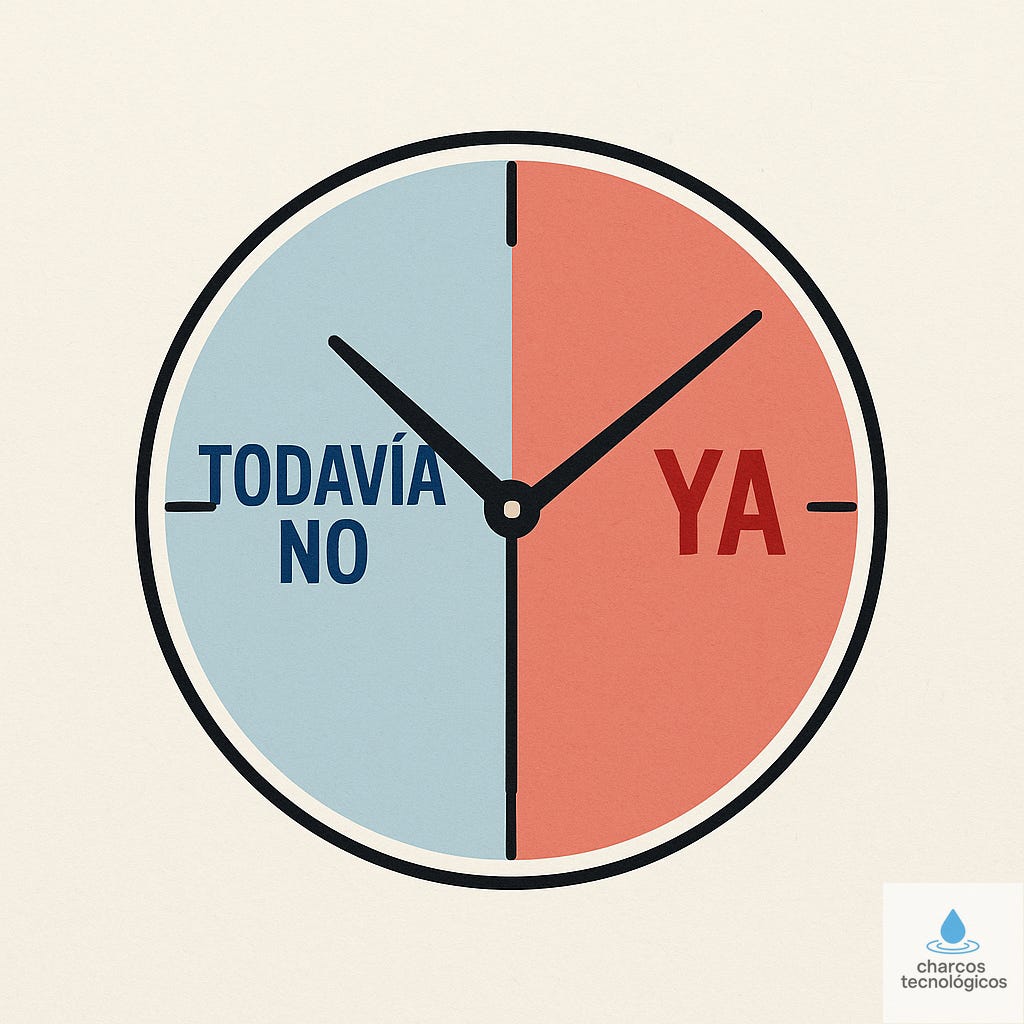
Image generated with ChatGPT On Tuesday, we met with some well-prepared clients whose product I foresee great success for. At the end of the meeting, they confessed that while they would like to launch now, they wanted to wait until they had something they felt comfortable with.
In other words, the exact opposite of what many gurus who claim to be experts in agile, lean startup, and other trends recommend.
Needless to say, we completely agree. It’s not about launching the final product or loading it with a thousand features that perhaps no one will ever use, nor about polishing every detail as if it were jewelry. It’s simply about identifying what the core of the product is and making it solid and convincing.
Everything else is selling smoke (or hypervitaminized PowerPoints).
🕒 Summary for busy people
Estimated reading time for the full article: 12 minutes.
We are obsessed with launching as soon as possible, as if speed were a guarantee of success. But there is nothing more expensive than launching without being ready. And nothing sadder than a product that dies because it was born too soon.
Launching well is not about jumping into the void: it’s about understanding what problem you are solving and when the market and your proposal are ready. Intuition sometimes counts as much as data, and patience can be a competitive advantage.
It’s not about waiting forever or running blindly, but about finding that point where the story you tell starts to hold itself up. That is the exact moment.
Throughout my career, I have participated in four startups and collaborated in the launch of dozens of products, some successful, others with little traction. I don’t consider myself one of those serial entrepreneurs, just someone who has experienced firsthand how difficult it is to launch a product.
In the startup world, we have memorized the lean mantra: prototype, validate, iterate. It’s a great idea with a bad collateral reputation: haste. As if lean were synonymous with “light,” with “express.” That idea has created a religion of urgency with a very clear liturgy: if you’re not launching every week, you’re dead.
The result: products that come out green and go back into the kitchen, teams with self-esteem in the gutter, and customers who end up trying something half-baked and classify it in the “meh” drawer forever.
I don’t demonize launching early. I’ve seen products that found their niche precisely because they arrived with the minimum and learned just enough. What I dispute is the dogma. “Ship it” as faith. “Ship it” as superstition that protects you from your fears. “Ship it” as an excuse not to think.
In that sense, launching very quickly can be like taking a penalty kick blindfolded: maybe you’ll get lucky, but usually, the ball ends up in the stands.
The question, then, is not “Should I launch now or not?”, but “Who is on the other side when I launch?”, “What real tension does this resolve today?”, “What story can I tell that isn’t a PowerPoint?”.
Product market fit or intuition?
Since product market fit —that moment when a product meets a strong and sustained market demand— belongs to the realm of social sciences and not the exact sciences, it’s impossible to know for sure when the ideal moment to launch is.
That’s why, and although it’s always good to do your homework and have a solid plan, don’t we also need some intuition?
I wouldn’t want to resort to the overused example of Steve Jobs, but it’s illustrative. Jobs boasted not only of knowing when to launch what his customers wanted. He knew they would want it (desire it, in fact) before they even did.
We have other cases, like the more than 5,000 prototypes that James Dyson designed over a decade to launch a vacuum cleaner that didn’t need a bag… when no one was complaining about bags. Or Nintendo’s Wii, much less powerful than the PlayStation or Xbox, but more family-friendly and playable, which sold over 100 million units.
We also have examples of the opposite: the Apple Newton (1993), the precursor to the iPad. It had a touchscreen, stylus, and handwriting recognition, but the market and technology weren’t ready. Jobs canceled it when he returned to Apple. Years later, he launched the iPhone with the same central idea, but at the right moment.
Or Webvan (1999), a grocery delivery startup twenty years before the market —and logistics— were ready. It failed miserably, but its model is now almost identical to that of Instacart or Amazon Fresh.
I don’t mean to say that the timing of a launch depends solely on a divine gift available to a few, but we shouldn’t rely entirely on trends either. And yes: launching the first thing you have is more about trend than method.
Sometimes it’s not you, it’s the calendar
I’ve seen ideas that were ahead of their time fail with dignity. They were good, but the ecosystem wasn’t ready to accept them. I’ve also seen mediocre clones succeed a year later.
Conventional wisdom says that the first one eats the market. The reality is that sometimes it eats the cost of evangelizing it. While you explain why your solution matters, another arrives with a simplified pitch, clearer ideas, and the precise moment.
So what can you do to have a chance? Do the work that isn’t heard and isn’t seen. Talk to users face to face. Identify patterns that don’t yet have names. Note the objections and turn them into opportunities. Learn to distinguish whim from need.
And when the moment comes, **don’t launch “quickly,” but with rhythm.
Minimalism vs. stinginess
MVP means minimum viable product. The problem is that many take it as “minimum tolerable.” “It’s not that bad,” we say, like someone going out to dinner in a promotional t-shirt because “after all, it’s a pizzeria.”
The user is not your grandmother, so they won’t tell you that you’re the most handsome in the world. The user is suspicious by default. If your MVP looks like an eternal demo, the verdict is that there is no product, just a promise that you may not be able to fulfill.
A good MVP is precise. It removes embellishments, yes, but doesn’t cut muscle. It doesn’t require tutorials because it is explicit and simple. And, above all, it solves a problem unequivocally and realistically.
💬 The biggest mistake is not launching late, but showing something too early that they will never be able to “unsee.”
—Does your proposal produce a visible transformation? Or does it just reduce the friction of a process that no one cared about? —I don’t know 🤷♂️ —Then go talk to ten people who don’t owe you favors and listen to them carefully.
The economy of first impressions
Here’s another heresy: sometimes it’s better not to appear everywhere at once. The temptation to jump to fame is enormous: launch on Product Hunt, interview on Hacker News, epic posts on LinkedIn, wannabe video on TikTok…
Mass exposure serves those who are already solid and can absorb what comes their way. You can’t open a restaurant when you haven’t finished setting up the tables.
There’s a more honest alternative: layered takeoff. First, a circle of trust that can question your assumptions. Then, pilot customers with a symbolic contract —sometimes for zero euros— that force you to pay attention. After that, a public beta with exceptional support. And finally, the big announcement.
This is not cowardice or insecurity, but damage control. It’s the difference between a stumble that teaches you a lesson and a fall that leaves you with a permanent limp.
Signs that you are ready (and that you are not)
✅ LET’S GO! When you present the product and people fight for access. They don’t say “how interesting,” they say “when? how much? can I invite two more?”. The urgency is shared.
🟡 Wait a minute. When the demo depends on you narrating it with passion. If the value evaporates in twenty seconds of silence, you’re still showing an idea, not a product.
✅ GO, GO, GO! When your beta testers don’t give you cosmetic feedback (“move the button to the left”), but usage cases (“yesterday I solved something in two seconds that used to take me 40 minutes”).
🟡 Hold still. When you need a glossary for them to understand you. If your product depends on educating the user in your jargon, you might be asking the world to move to your language.
And, above all, a rare but definitive signal: when anyone can sell it. If another person on your team —or a customer— can explain it and convince, you have something solid. If only you know how to tell it, it’s still your project, not our product.
The fear of “not yet”
Sometimes we rush out of fear of not being yet. “If I don’t launch, I don’t exist.” It’s very similar to that teenage anxiety of posting something on Instagram every two days “so they don’t forget about me.”
The world is not going to forget about you for not launching this week. It will forget if you launch five mediocre things in two months. The noise also accumulates and eventually exhausts.
We think that “going out” gives us identity. The opposite happens: it’s the identity that allows you to go out without disintegrating.
If you know what problem you are tackling, what sacrifices you accept, what you won’t do even if asked a hundred times, then the first blow doesn’t knock you down: it centers you.
Building without obsessing (and without deceiving yourself)
Let’s talk about the other extreme: the paralyzing perfectionism that never publishes. It’s not love for detail; it’s fear of exposure. It’s “I want to be liked” instead of “I want to be useful.”
But the world doesn’t owe you affection. In fact, it owes you nothing. You are the one who comes to solve a problem, to meet a need. With ingenuity and effort, you can earn a bit of trust.
Here I can give you two firsthand tips:
1. Define in advance the operational minimum of your product. If we’re talking about an online store, what less than having a navigable catalog and being able to buy without friction? You can add more payment providers and cutting-edge features later. You can’t launch without that, but you also don’t need the accessories.
2. Don’t promise what you can’t deliver. Be clear with your value proposition. If you promise to open a platform where employees can be evaluated with the data the company already has about them, they won’t ask you to also manage payroll.
But if, on the other hand, you sell yourself as “the ultimate solution for Human Resources,” be prepared for them to ask for time tracking, digital signatures, and unlimited vacations.
Ambiguity comes with impossible expectations. Better to be a hammer that hits a precise nail than a Swiss army knife that opens and breaks in half.
What matters is not to promise little, but to promise exactly what you can uphold when the first real customer arrives, not the demo investor.
Who buys from you when no one knows you?
The market is not a neutral or fair jury. It comes with its backpack of experiences, prejudices, and fatigue from everything it has seen succeed and fail.
Your category may be burned by a previous bad actor. Your distribution channel may be saturated. Your price may be perfect and still bad for the moment: too low smells cheap; too high, like a consultancy.
That’s why timing is not just “when do I launch,” but “when do they accept me.” Sometimes it’s worth delaying a month to take advantage of a global conversation (a news item, a regulatory change, the fall of a competitor…). Other times, it’s better to go out early to claim a word that hasn’t been overused yet.
What if we launch “small” but with greatness?
You can launch quietly and with dignity. The key is not to sell humility, but focus.
“We do one thing, we do it well, and we don’t apologize.”
That phrase, well executed, changes the energy of an MVP. It stops being “sorry for the inconvenience” and becomes “try this, it saves you twenty minutes every morning.”
People respond better to utility than to drama.
And if someone thinks it’s not enough, take a deep breath and smile. That person is not your customer, or at least not right now.
One thing worse than launching late is launching for everyone at once. The “for everyone” does not exist; only the “for you, here and now” exists.
Two confessions to close (almost)
First: I have regretted hasty launches that imposed a glass ceiling. It was never a serious bug or an incomplete design. It was the feeling of “oh, was that it”, which takes years to dismantle.
Second: I have also regretted perfectionisms that made us miss waves. That energy that dies between prototypes and documents. That conviction of “when it’s perfect, everyone will love us”, which always comes when the horn has already sounded.
The conclusion doesn’t fit in a slogan, but it’s quite simple: neither the anxiety of “now, now, now”, nor the insecurity of “not yet, we’re not ready.”
There, in the middle ground, lies the difficulty and personality of each one to know when the exact moment is. That’s why many fail and some succeed.
Do you prefer to be the first to arrive or the one who will remain? They are different races that often win different people.
💌 Did you find this article useful? Share it so it reaches more people.
🚀 Weekly reflections like this in your inbox. Subscribe to Charcos Tecnológicos
References
- Eduardo Castro (2012). *Interview with James Dyson. The story of the first bagless vacuum cleaner. *culturamas.es
- Wikipedia (2025). Wii. wikipedia.org
- Wikipedia (2025). Apple Newton. wikipedia.org
- Wikipedia (2025). Webvan. wikipedia.org