The Table Slam: From Attention to Scandal
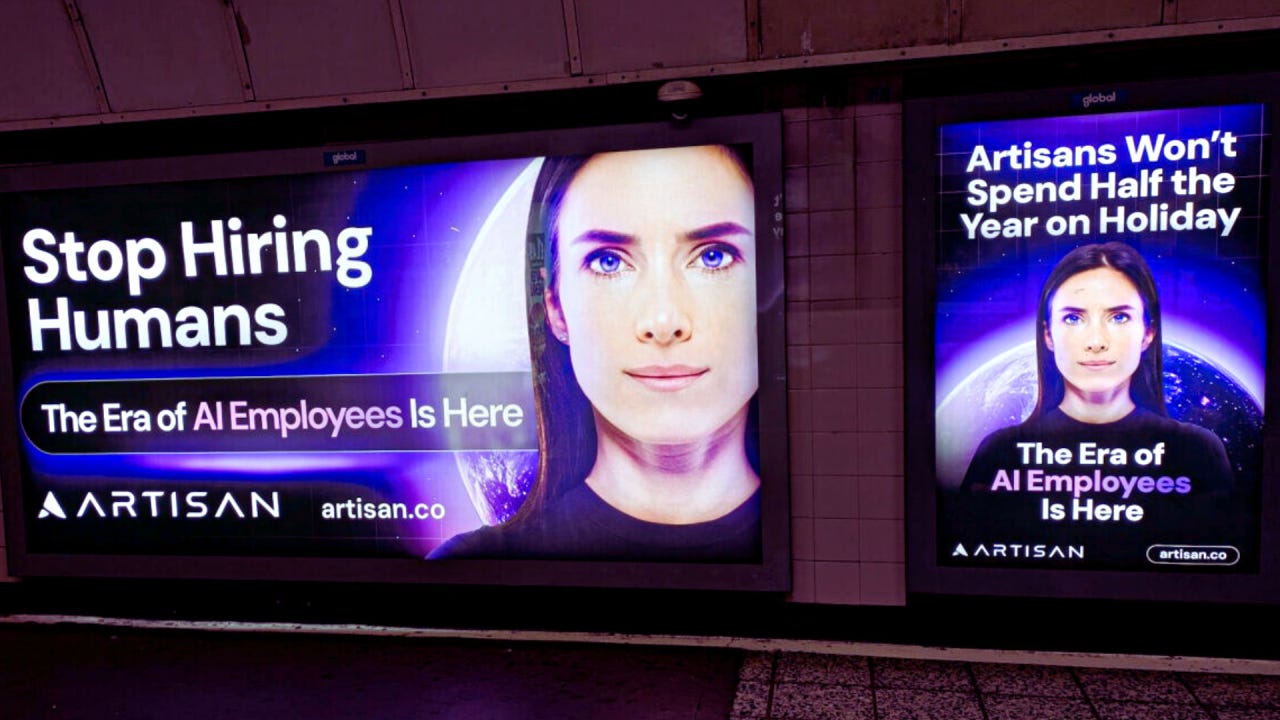
In San Francisco, where every billboard promises to “revolutionize AI” or “reinvent the future,” Artisan decided to take a different path:
Stop Hiring Humans
The message was as simple as it was incendiary. Their flagship product, Ava, is an AI Sales Development Representative (AI SDR), and their goal was clear: to stand out in a saturated market of solutions that sound the same. But to do that, they had to provoke. And boy, did they succeed!
The company acknowledged that their intention was pure rage bait — that is, to deliberately provoke outrage. And they achieved it: millions of impressions, global media coverage, and a torrent of death threats that, unfortunately, also came included in the package.
In the short term, it worked. Artisan generated over two million dollars in new revenue and made their name synonymous with AI Employee. But in the long term, the question remains: how much does it cost to play with fire when the message is perceived as dehumanizing?
Although Artisan now wants to present itself as a company that “loves humans”, their campaign awakened the most primal fear of the 21st century: being replaced by a machine.
🕒 Summary for Busy People
Estimated reading time for the full article: 10 minutes.
Artisan’s “Stop Hiring Humans” campaign was brilliant in impact and disastrous in content. It worked because it struck the nerve of the fear of being replaced by machines. It sold millions, yes, but at the cost of normalizing dehumanization as a marketing strategy.
It’s not just about provocative advertising. More and more brands confuse attention with trust and virality with purpose. In the short term, they gain clicks. In the long run, they lose soul.
In the face of that noise, it’s worth remembering those who did the opposite — like Tony Hsieh, who turned empathy into a business model — and asking ourselves whether we want to amplify efficiency or meaning. Because if the future of work is framed in slogans like “stop hiring humans”, the problem is no longer AI. It’s the language we use to justify it.
Between Sarcasm and Dystopia
Perhaps Artisan doesn’t have bad intentions. Perhaps their goal was more philosophical: to make us reflect on how we use our time and automate the tasks that no one enjoys.
But the problem is not the intention, but the precedent.
Artisan’s success demonstrates that provoking fear sells, and that opens a dangerous door: other companies might think that unleashing workplace anxiety is a good branding strategy. If rage bait works, why not repeat it?
And that’s where we enter Klarna territory.
Klarna and the Bill of Dehumanization
Klarna, the Swedish payment giant, replaced about 700 customer service employees with AI a couple of years ago.
The result was a silent disaster: a drop in quality, frustrated customers, and a massive loss of trust that coincided with a valuation plunge from $45.6 billion to $6.7 billion.
Its CEO, Sebastian Siemiatkowski, ended up admitting that “prioritizing cost over quality was a mistake.”
In the end, they had to rehire human agents and adopt a mixed model: AI for the repetitive, people for the complex.
The lesson is clear:
Replacing people may seem profitable in the short term, but regaining lost empathy can cost seven times more.
And the most ironic part: while Klarna learned that lesson the hard way, Artisan was cashing in by provoking the same fear that led Klarna to lose it.
Tony Hsieh and Happiness as Strategy
More than a decade ago, Tony Hsieh wrote Delivering Happiness, the manifesto that turned Zappos into an icon of customer service. His thesis was simple and radical: customer service is not a cost. It is the essence of the business.
In a world where almost all companies say they “focus on the customer,” few actually do. Most still see customer service as a necessary evil, an expense to cut when crises arise.
However, Hsieh demonstrated that sustainable growth comes precisely from treating your employees and customers as people, not as variables in an efficiency model.
In a world that idolizes efficiency, we have forgotten that human warmth also scales. And it does so better.
Ludism 2.0: From the Hammer to the Tweet
Campaigns like Artisan’s not only generate clicks: they reactivate modern ludism. In the past, workers broke looms out of fear of losing their jobs; now, we post threads on X or insult CEOs on LinkedIn. Technology changes but fear remains.
Artisan claims that their goal is “to make jobs more human.” It sounds nice, and it might be true. But the underlying problem is not AI: it’s the narrative we use to sell it.
Because if the story we tell to promote automation is “stop hiring humans,” we are not making jobs more human. We are dehumanizing language, empathy, and ultimately, purpose.
What Remains to Learn
Perhaps Artisan is not the villain, but the symptom. A symptom of an industry that measures success in clicks, not in trust. That celebrates scandal because the algorithm rewards it. And that, deep down, has forgotten what it means to work for — and for — people.
There is nothing more human than being afraid of ceasing to be one.
Addendum, October 30, 2025
Not even 24 hours have passed before I came across an even more outrageous slogan:
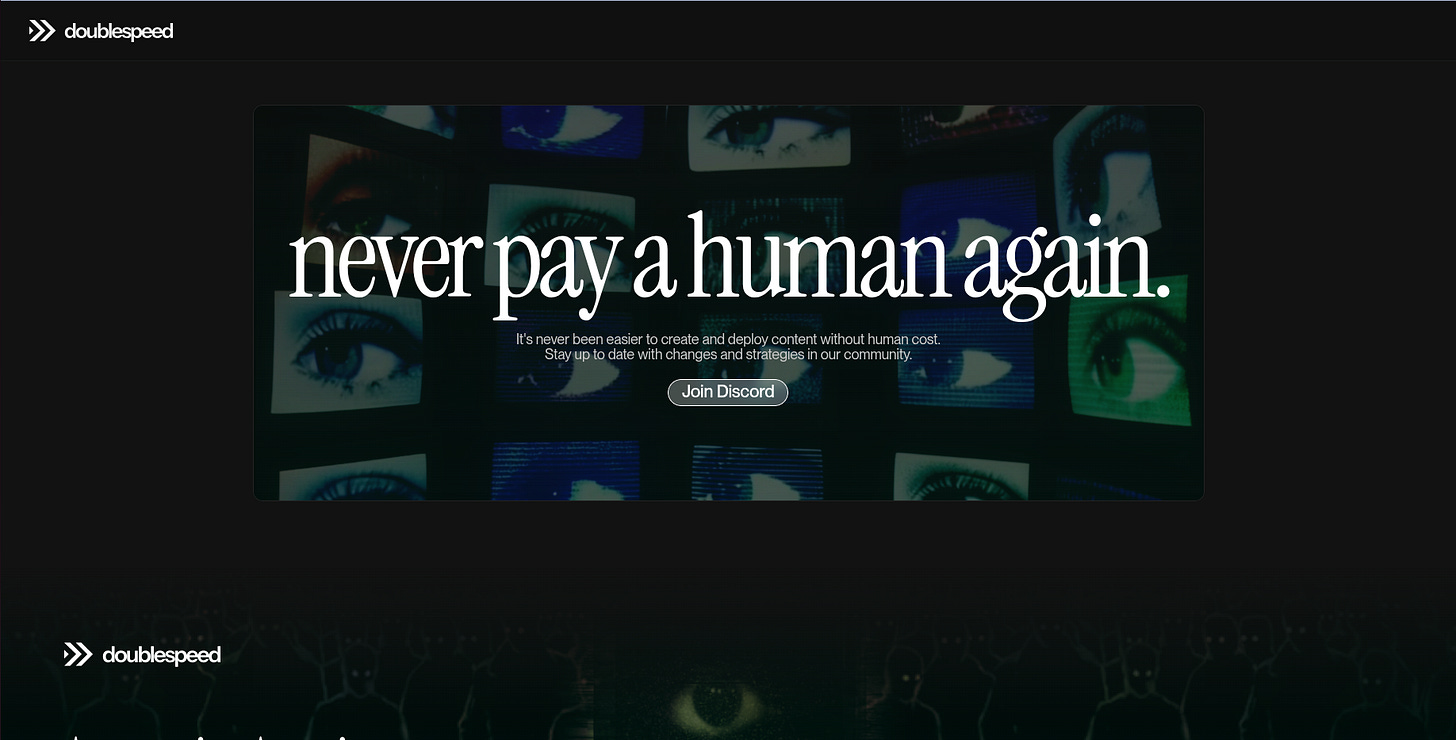
It’s the first time I’ve heard of doublespeed, and from the tone of the entire website, and the fact that they don’t even have a single sad pricing page, I’m tempted to think it’s a joke. But it precisely emphasizes what we’ve already discussed: we’re going to use fear, insecurity, and drama to gain attention. Which, considering they promise to “automate attention,” takes on a rather sinister Orwellian touch.
Not to mention that they are proposing to fill social media with (more) junk. The next Artisan, or the end of the organic era?
Addendum (II), October 30, 2025
With a little more time to dive in, I found an article that lends legitimacy to doublespeed, especially since it’s true that the venture capital firm, Andreessen Horowitz, backs the project, which has already raised around a million dollars.
When I say it “lends legitimacy,” I mean that it doesn’t seem like trolling. I still think it’s a horrible, harmful, and unethical idea. But what do I know.
🚀 Weekly reflections like this in your inbox. Subscribe to Tech Puddles
References
- Artisan (2025). The Story Behind the “Stop Hiring Humans” Billboards in San Francisco. artisan.co
- Megan Cerullo (2024)**. **Klarna CEO says AI can do the job of 700 workers. But job replacement isn’t the biggest issue. cbsnews.com
- Tony Hsieh (2010). Delivering Happiness. wikipedia.org
- Emprendedor (2025). Cómo opera Doublespeed: una startup financiada para generar spam social a escala. emprendedor.com