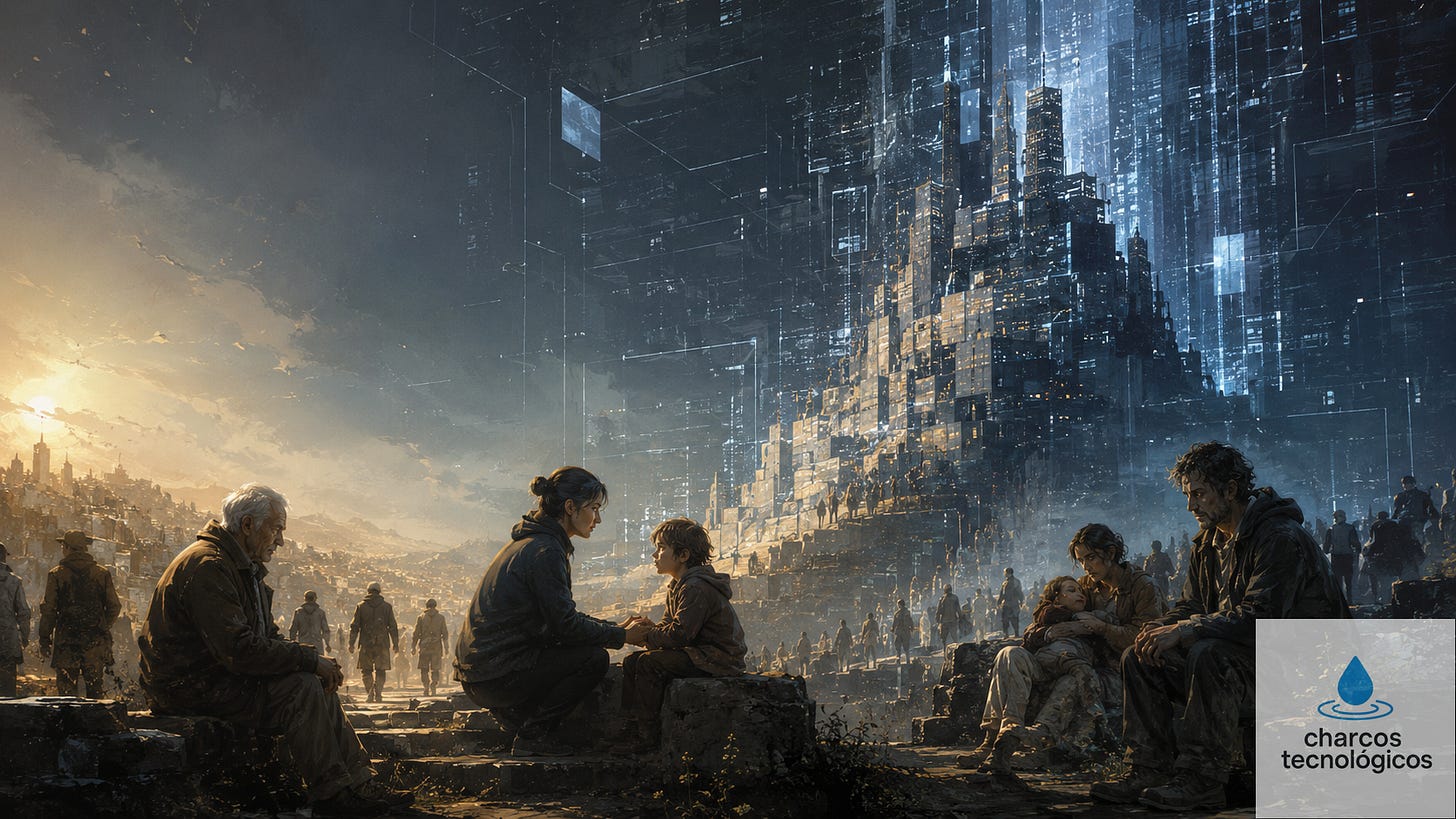
Image generated with ChatGPT.
Efficiency as Morality
For some time now, I have been amazed by the dizzying race towards infinite productivity. I have nothing against efficiency; that would be absurd. It allows us to heal sooner, build better, waste less time, and free up energy for more important things. The problem arises when it stops being a means and becomes a morality.
Every day, new tricks emerge to triple, quintuple, or multiply human capabilities by 10,000. Do they know what that promise truly entails? However, almost no one tells us why. Are we solving the great problems of humanity, or do we just want to improve the bottom line?
And I say this from fascination, not rejection. Technology interests me; it has given me skills, tools, and possibilities that would have seemed like magic twenty years ago. AI can expand our capabilities in ways we are just beginning to glimpse. Precisely for that reason, I am so concerned that we end up reducing an immense promise to a machinery without purpose.
It is important not to confine this obsession to the labor market. What about the sick, the elderly, the children, those who live in countries where they lack access not only to AI but also to running water, electricity, computers, or the internet? What about those who cannot produce enough, those who do not optimize their lives well, those who do not fit into the new systems of invisible scoring that are beginning to order the world?
I am referring to all of us.
Because sooner or later, we will all be inefficient. We will all be slow. We will all be dependent. We will all need someone to wait for us.
Babel or Jerusalem
The encyclical Magnifica Humanitas from Pope Leo XIV arrives at a strange moment. For years, we have talked about artificial intelligence as one talks about a tool. A sophisticated tool, yes. Fascinating, unsettling, useful, dangerous, but a tool nonetheless. And that may already be the first trap. Because a technology that decides what we see, what we buy, whom we hire, what credit we receive, what reputation we deserve, or what opportunities are opened to us is not a simple tool. It becomes the environment, moral architecture, a way of seeing the world.
The Pope presents it with a powerful image: Babel or Jerusalem. Babel as a project of domination, uniformity, and self-sufficiency. Jerusalem as shared, humble, patient, community reconstruction. It is not a technical choice. It is a spiritual choice. Or, if one prefers to say it without religious language, an anthropological choice: what kind of human beings do we want to continue being.
And this is where this encyclical directly touches on something I have been trying to express in this series of articles about shared experience. I have written about empathy, creativity, fear, doubt, and humor as traits that do not make us more perfect, but more human. They do not save us because they make us invulnerable. They save us precisely because they arise from our vulnerability.
We are moved by a foreign story because something in us recognizes a wound that may not have been lived but could be lived. We create because we need to heal, to console ourselves, or to start a conversation with someone we do not yet know. We feel fear because we know we are small. We doubt because no truly human answer comes without passing through a shadow zone. We laugh because sometimes there is no other way to look at the abyss.
AI can imitate many of those things. It can write an elegy, tell a joke, simulate comfort. It can respond with apparent prudence. It can even seem compassionate to us. But it has not lost anyone, nor does it fear death, nor is it ashamed, nor does it remember that afternoon when it made a fool of itself. AI does not need hope.
And without hope, there is no humanity, only calculation.
That is why I find it so relevant that Magnifica Humanitas insists on intrinsic human dignity. Beyond wanting to dress dignity with prestige, merit, or as the result of a well-managed life, it articulates it as something that is not earned and, therefore, cannot be lost.
This idea, which may seem abstract or pious, is today one of the most radical assertions that can be made.
Much of the contemporary technological imagination is directed precisely in the opposite direction. It tells us that the human being is a defective project. They want to sell us the idea that we are an improvable organism, a sum of limitations that must be corrected. Illness, old age, slowness, dependence, sadness, even death, appear as errors of the system. Failures that a sufficient combination of data, biotechnology, capital, and computing power could resolve.
At first glance, it sounds good. Who wouldn’t want to suffer less? Who wouldn’t want to cure diseases? Who wouldn’t want to alleviate loneliness, disability, deterioration, pain?
The Discarded
But are we combating suffering, or has a subtle battle against the sufferer begun?
Here emerges a new form of eugenics. Not necessarily with white coats, racial speeches, or clandestine laboratories. A cleaner, more presentable eugenics, more integrated into dashboards and roadmaps. A technological eugenics that does not need to say “this life is worth less.” It is enough to say: “this life is less efficient,” “this life is less profitable,” “this life is less scalable,” “this life slows down the system.”
And then exclusion no longer seems like violence. It seems like optimization. It starts to sound acceptable.
The danger is not that a machine becomes perverse and threatens our existence, but that we accept as something natural a morality whose backbone is net performance. That we assume without resistance that an algorithm classifies people according to their apparent utility. That we call progress a world in which the powerful become more powerful and the fragile dissolve into cost, sidelined in statistical noise.
Is it AI that thinks like us, or are we the ones starting to think like a bad AI?
The encyclical is not a rejection of technology. That would be absurd, as well as ungrateful. Technology has allowed us to cure diseases, communicate at a distance, explore space, look inside the body, delve into the intricacies of the subatomic world, and free millions of people from tedious jobs. AI can be part of that bright story. In fact, it should be part of it. But only if it remains an extension of the human and not an excuse to classify it.
Because no technology arrives in the world in a vacuum. It comes with built-in priorities: what it optimizes, what it measures, what it ignores, what it considers acceptable. It takes on the face of those who design it, finance it, regulate it, and use it. And right now, much of that face belongs to tech conglomerates with more resources than many states, with fewer democratic control mechanisms than a public administration, and with an unprecedented capacity to shape the collective imagination.
For centuries, we have feared that power would come armed. Now it also comes personalized, gamified, and wrapped in convenience. It does not enter by kicking down the door, but through a monthly subscription.
The right questions now, aside from what AI will be capable of doing tomorrow, are who sets the criteria for its use, who translates our humanity into variables and processes, and who benefits from it. And above all, who is left out of this system that no one has chosen.
Because one of the most dangerous traits of automatic systems, as we saw in relation to autonomous cars, is that they depersonalize injustice. As no one makes the concrete decision, as no one exercises cruelty in a patent way, as no one directly condemns you, responsibility dissolves. It is the system that determines that you do not meet the parameters. So you do not fit.
Hope as Resistance
Here hope ceases to be a decorative virtue. Hope becomes a form of resistance. To hope is not to trust naively that everything will turn out well, which would be more of a form of anesthesia. To hope is to refuse to accept that the future necessarily belongs to those with more data, more servers, more capital, and more power to impose their vision of the world.
Hope is to proclaim that not everything is decided.
Or do we want to accept that the weak must adapt to the pace of the strong? That education consists of preparing children to obey automatic systems? That working, something that has always dignified us, involves competing against machines in a race designed by others? That old age is an uncomfortable residue? That disability is an error? That sadness should be medicated with infinite entertainment? That a person is worth what they produce, what they consume, or what a model predicts about them?
It is not decided, unless we give up.
Perhaps that is why I am so interested in the expression “shared experience.” Because it does not point to an isolated quality, but to a fabric. We are human because something happens to us and because that which happens to us can reach others. A human life is not a processing unit. It is a biography traversed by bonds, losses, desires, failures, clumsiness, gestures of care, and small loyalties that do not fit into a dashboard.
Human dignity is not in our intellectual superiority. That boundary, if it ever existed, is becoming blurred. Nor is it in our ability to produce beautiful objects, solve problems, or accumulate knowledge. All of that can be imitated, augmented, or surpassed.
Dignity lies in the fact that each person is someone and not something.
And this, which seems so simple, is precisely what we will have to repeat with more strength in the coming years. In the face of systems that classify. In the face of markets that discard. In the face of companies that optimize without responsibility. In the face of discourses that promise an augmented humanity while leaving behind concrete, tired, sick, contradictory humanity, in need of love and time.
I do not know if we are building Babel. Sometimes it seems so. An immense tower of data, automation, promises of immortality, and a single language. A tower so bright that it is hard to see the bodies that remain in its shadow.
But I also do not believe that everything is lost. We can still rebuild something. Not from nostalgia or fear, but from an uncomfortable and demanding hope. A hope that does not wait idly. A hope that regulates, educates, discusses, limits, and protects. A hope that gets its hands dirty.
Because if Magnifica Humanitas reminds us of anything, it is that the decisive question is not what machines will be able to do. The decisive question is what we must not cease to do.
Care for the weak. Defend the slow. Listen to the one who does not count. Protect the one who cannot protect themselves. Doubt when everything seems too clear. Laugh at our own pretension of greatness. Create something that comforts those who come after. Look at a broken person and see not a failure, but a mystery.
Our lives depend on it.