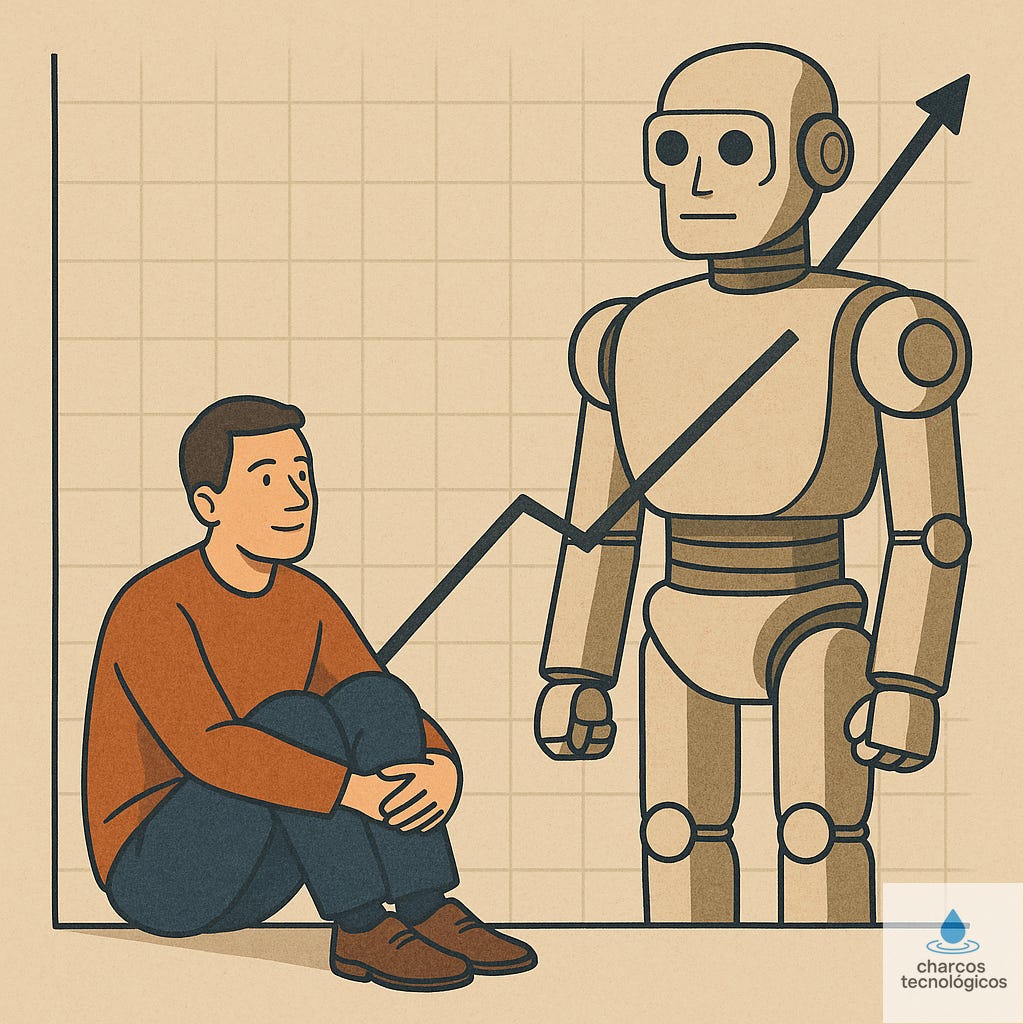
Image generated with ChatGPT
The story of human progress has always been a story of speed. First, we wanted to move faster, then produce faster, and now, thanks to artificial intelligence, learn faster.
The problem is that no one has taught us how to slow down.
Last week, I launched a survey to choose the topic of this newsletter. Although the decision was close, this topic won, perhaps because we are all feeling it firsthand: the fatigue of having to move forward without pause. It is a matter that has interested me for a long time and is becoming more urgent every day.
🕒 Summary for busy people
Estimated reading time for the full article: 10 minutes.
We live trapped in the illusion of constant progress. Artificial intelligence promises us to move faster, but at the cost of understanding less and less of what we learn.
Speed has become a virtue, and rest, a guilt. We jump from tool to tool, convinced that stopping is going backward, when in reality, what we lose is focus. Fatigue transcends the merely physical. It is cognitive anxiety.
Perhaps true progress lies in knowing how to stop. In choosing what is worth learning, understanding it slowly, and letting the rest fade away without remorse. Because there is no possible learning without pause, nor clarity without stillness.
The trap of infinite learning
Until recently, technical knowledge advanced quickly but within limited territories. You could specialize in a language (Java), a framework (Symfony), or a discipline (cybersecurity) and remain relevant for years with reasonable learning.
Currently, changes occur across all layers at once: language, environment, mental model, and even the way we conceive projects. If we used to go to library1 once a quarter, now we change paradigms every month. And the result is that, no matter how hard we try, no one can cover it all.
That perpetual urgency to not fall behind has a name: cognitive anxiety.
And AI, with its impossible rhythm of versions, papers, and benchmarks, is its fuel. We no longer learn to create. We learn to remain relevant.
The illusion of progress
For years, continuous improvement was a healthy principle. We made small iterations that condensed sustained learning and applied corrections based on changing needs. But the current landscape has shifted from continuous improvement to compulsive progress, with a sense that is increasingly blurred (perhaps for the better).
The main problem is that behind all this inertia, there seems to be very little deep understanding. Not all novelties are advancements (for example, Microsoft resurrecting Clippy), nor does speed always provide the desired quality. And of course, even if everything is moving, the direction may not be right. I say this because current models lead us to a crazy energy consumption, with no one seeming willing to bear the real cost of progress by solving an inherent problem of technology.
It’s not that AI is replacing humans. It’s that humans are trying to replace ourselves.
The phrase sounds dystopian but is not far from reality. Most (or those who shout the loudest) are not content to delegate to AI, but seem to want to become it. Precise, fast, efficient, and without pauses. But we forget that a life without pauses also lacks focus.
Progress as culture (and punishment)
Culturally, we have turned progress into a religion. We celebrate updates, launches, private betas, and keynotes, prioritizing novelty over quality, functionality, or meaning.
The result is an exhausted society, unable to distinguish between evolution and overload. And this fatigue affects not only developers. Teachers, designers, doctors, journalists… everyone feels that if they stop for a second, the world will leave them behind.
That’s why so many professionals live trapped in a loop of constant training, but with the feeling of not knowing anything in reality, of not mastering even a fraction of what they should or would like to. Sure, Socrates warned us that with more knowledge comes greater ignorance, but I doubt he imagined the pace at which we are subjecting ourselves today.
The vertigo of permanent change
AI amplifies the feeling of vertigo because it evolves at a pace that escapes our ability to keep up. It still doesn’t change on its own, but the volume of research, updates, and new layers of tools being built on it generates the illusion of automatic and continuous progress.
We live surrounded by changes that chain without pause, leaving us in a strange role: that of spectators of a future that seems to advance without asking for our permission.
Each advancement promises to free up time but ends up generating more pressure. The paradox is brutal because the more productive we are, the less we feel we are advancing.
And in that context, the pause becomes an almost subversive act.
How to survive the syndrome of constant progress
No one can escape change, but perhaps we can try to avoid being devoured by it. Here are some pragmatic ideas to maintain sanity:
1. Learn slowly what matters
Don’t try to master all the new tools. Every time a new acronym or model appears, remember that 90% won’t survive the next year. Choose a solid foundation and delve into it.
Learning slowly is a bet on understanding over mere accumulation. Just as we don’t intend to compete with a calculator in speed, let the LLMs digest all knowledge and leave us with the judgment.
Over the years, I have found several times that in technology, patience can be a competitive advantage. You let others pave the way, and when you decide to accelerate, the asphalt and signs are already there. Those who start may have an advantage, but if they only apply speed, they end up wearing themselves out.
2. Set aside time to understand
We live in the culture of the tutorial. Copy & paste, and if it works, we move on to the next. But understanding requires pause. Documenting, writing, teaching, or discussing what you’ve learned are acts of reflection.
Paraphrasing Richard Feynman: you don’t understand something until you can explain it in simple words.
That explanation, even if just for yourself, is what transforms fleeting knowledge into real learning. And without that process, everything you know ends up being a blurry memory of a YouTube video.
3. Accept obsolescence as part of the process
Not everything you learn will be useful tomorrow, and that’s okay. Learning is, to a large extent, discarding.
Instead of getting frustrated by what is no longer valuable, appreciate what it taught you about how you think, structure, or solve problems. One of the advantages of AI is that it doesn’t require us to know everything, but rather the crucial thing, which is to have the judgment to discriminate. And that, curiously, is the only thing that doesn’t age.
4. Disconnect without guilt
Stop viewing rest as unproductivity. Without rest, we are not human beings. We need it to renew ourselves and oxygenate our ideas. If you don’t disconnect, everything you’ve learned fragments and loses meaning.
It’s important to have a hobby, enjoy leisure without feeling guilty, and get bored from time to time. Although I don’t preach by example here. I think I haven’t been bored since I was fifteen. And as we are learning, boredom is something tremendously positive.
5. Measure progress by depth over quantity
In a world that measures everything in metrics (followers, commits, versions, processed tokens), the true rarity is depth. Knowing less but understanding better, in a world saturated with superficial information, provides a clarity that no tool can replicate. Borges summarizes it with delightful elegance in the dedication to Leopoldo Lugones that opens El hacedor (1960):
[…] poor practice matters less than sound theory.
The value of staying still
What if progress consists in knowing how to stop? In looking back, organizing what we have learned, and choosing what is worth keeping. We have machines to accumulate, which do it better than we do.
Not every advancement is an improvement. Sometimes, constant movement only raises dust made of haste and noise that ends up clouding our vision just when what we need most is clarity.
And the pause is neither regression nor stagnation. The pause is necessary to know if we are orienting ourselves correctly. And it is beautiful because it allows us to contemplate the landscape.
In a world that celebrates acceleration, the pause becomes a luxury, an act of silent rebellion against the mandate of “faster, better, cheaper” (the “faster, better, cheaper” of Daniel Goldin). Those who learn to slow down to look with intention and meaning end up progressing more and better. 0:00-22:10Audio playback is not supported in your browser. Please update it. And if not, as Ketama said, stop the world.
🚀 Weekly reflections like this in your inbox. Subscribe to Technological Puddles
References
- Psicofronteras (2024). What is cognitive anxiety? psicofronteras.com
- Santiago Neira (2025). Clippy returns, now with emotional AI and advanced features in Microsoft. infobae.com
- Claudia Rodríguez (2025). The importance of getting bored. hiancianeuropsicologia.es
- Jorge Luis Borges (1960). To Leopoldo Lugones. poeticous.com
- Daniel Goldin (1992). Faster, cheaper, better. wikipedia.org
- Ketama (1999). Stop the world. open.spotify.com
1 A library, from English library (often mistranslated as librería, which in Spanish refers to a bookstore), is a piece of software that implements or provides a specific functionality, reusable by other programs. For example, there are libraries for image processing (like Pillow in Python), database handling (like SQLAlchemy), machine learning (like TensorFlow), or creating graphical interfaces (like GTK). These are integrated into a project to avoid reinventing the wheel and promote efficiency in development.