
Image generated with ChatGPT. For centuries, the human body has exercised almost unconsciously. Walking long distances, carrying weight, working with hands, or maintaining balance were activities integrated into daily life. There was no need for routines or subscriptions because movement came naturally.
Today, however, we pay to artificially reproduce what we have stopped doing naturally. Gyms, personal trainers, tracking apps, monthly challenges. We haven’t become weaker. We simply need less physical effort.
And something very similar is starting to happen with the mind.
🕒 Summary for Busy People
Estimated reading time for the full article: 5–6 minutes.
Artificial intelligence does not make us less intelligent, but it can make us less mentally agile if we stop practicing the act of thinking. Just as happened with the body when the environment stopped demanding physical effort, the mind begins to delegate tasks that once trained our attention, reasoning, and judgment for the sake of comfort.
Thinking stops being automatic and becomes a conscious decision. When cognitive friction disappears, the risk is not stupidity, but dependency: losing mental autonomy and the ability to sustain problems without constant assistance.
In that context, it is not far-fetched to imagine mental gyms: spaces to train concentration, critical thinking, and decision-making without help. Not to be smarter, but to not forget how to think for ourselves. Because, as always, what we stop practicing eventually becomes a paid service.
Delegating as a Form of Forgetting
Each new artificial intelligence tool saves us time, reduces friction, and eliminates cognitive tasks that previously required sustained attention. Drafting, summarizing, structuring ideas, comparing options, anticipating scenarios. Everything is still there, but now it happens in seconds and with disconcerting ease.
The problem is not that AI “makes us stupid.” That argument is simplistic and, at its core, false. We remain just as capable as before. The change is more subtle: we are stopping to practice.
And the mind, like the body, does not rust all at once. It gradually becomes unaccustomed.
Mental Agility Also Atrophies
Talking about a loss of intelligence is an understatement. It seems that agility is starting to fail: that ability to hold a problem for minutes, explore paths without knowing if they lead to something, write without a script, make decisions without a prior simulation telling us what is optimal.
Mental agility is the ability to think even when it is difficult. When we systematically delegate, our attention becomes shorter, reasoning more dependent, and cognitive effort something to be avoided.
Artificial intelligence functions as a cognitive exoskeleton: it amplifies our capabilities, but if we never take it off, we end up forgetting how to walk on our own.
When Thinking Stops Being Automatic
For a long time, thinking has been an inevitable activity. The environment forces us to do so. Solving, remembering, calculating, writing, deciding. Not because we are particularly disciplined, but because there is no alternative. Thinking is not a virtue, but a condition for survival.
Today, many of those frictions have disappeared or are on their way to doing so, and with them, the constant need to exercise the mind is fading. Where there was once effort, we are beginning to see assistance. Where there were once doubts, there are now suggestions. Where there was once a process, we have immediate results.
This leads us to a peculiar scenario: thinking stops being automatic. It no longer happens by default. It begins to require intention.
Thinking becomes a conscious decision, almost a voluntary act. Something we do when we want to, not when we need to. And like everything that stops being necessary, it runs the risk of ceasing to be done, and of rusting.
The problem lies not so much in the mind as in the context, which has stopped demanding a continuous act. Cognitive friction, which for centuries was inevitable, will begin to be optional. And the optional, over time, tends to be abandoned for mere efficiency.
The Possible Birth of Mental Gyms
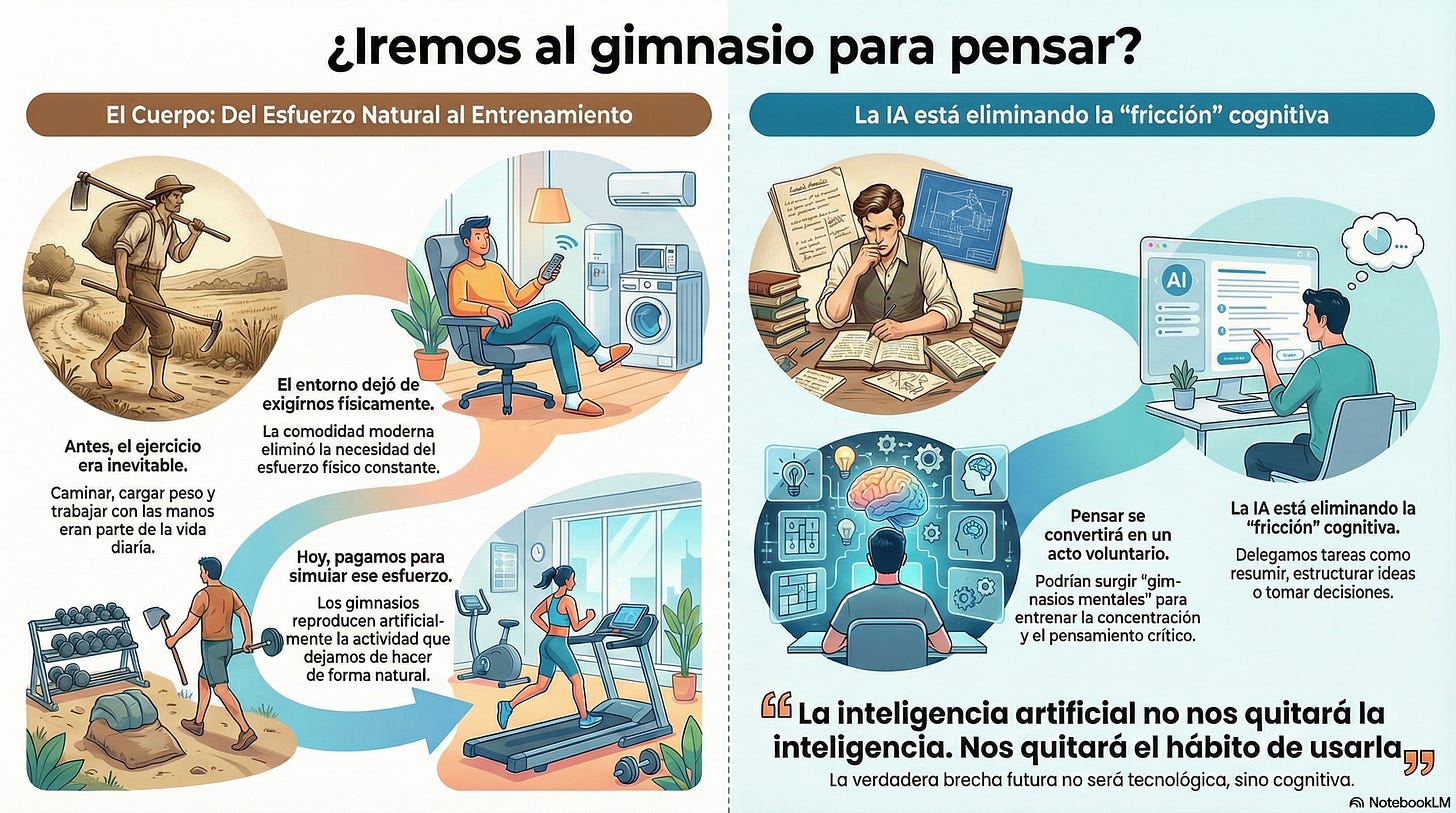
Image generated with NotebookLM. In this context, it is not far-fetched to imagine the emergence of spaces, physical or digital, dedicated to training basic cognitive abilities that we once took for granted.
Places where we will train what the environment no longer forces: deep concentration without interruptions, reasoning as a game and challenge, raw writing, without automatic suggestions or real-time corrections, decision-making under total uncertainty, active memory, sustained critical thinking.
Just as in the gym we do not learn to walk, but maintain the necessary musculature to keep doing so, these spaces will prevent us from completely delegating the act of thinking.
I am increasingly convinced that thinking is not only useful for producing but also for staying in shape.
Who Will Need to Train Their Mind?
Not everyone will feel this need at the same time. At first, it will probably be those who make a living by thinking: knowledge professionals, executives, creatives, strategists, people who need their own judgment and not just net efficiency.
Over time, the difference will become more apparent. Not between those who use AI and those who do not (I suspect that will be universal), but between those who maintain their mental autonomy and those who depend entirely on external systems to think.
We will no longer talk about a technological gap, which we will, but about an insurmountable cognitive gap.
There’s Nothing a Monthly Subscription Can’t Fix
Artificial intelligence will not take away our intelligence. It will take away the habit of using it.
And just as happened with the body, there will come a time when we will have to pay, organize, and ritualize what once happened naturally. Thinking will cease to be a reflex and will become a training.
Perhaps the future will not be filled with atrophied brains, but with people who, after delegating too much, discover that thinking well also requires practice.
And then, as always, someone will set a monthly fee and call it progress.
Update January 5, 2026
My colleagues at the Institute of Artificial Intelligence suggested I take a look at Brilliant.org. It is a concept very similar to what I present in this article, although I see it more as a technique gym than a **gym for autonomy. And the nuance is not trivial.
It is a mental gym in that you do not have to produce or deliver a result, and you exercise reasoning or mathematical intuition. Moreover, as I propose in the conclusion, it is a subscription service.
But it still falls short compared to what I envision as a mental gym. In Brilliant, logic, patterns, and abstraction are trained. All of that is very good. But the mental gym I imagine goes in another direction. We would train ambiguous decision-making, the formulation of good questions, thinking without a specific goal (thinking for the sake of thinking).
However, the fact that there is already a first generation of mental gyms evidences a need that will grow in the future. It will likely not be exactly as I foresee, nor will it be like what we currently have. And I suspect that, whether we like it or not, they will eventually find their place in our lives.