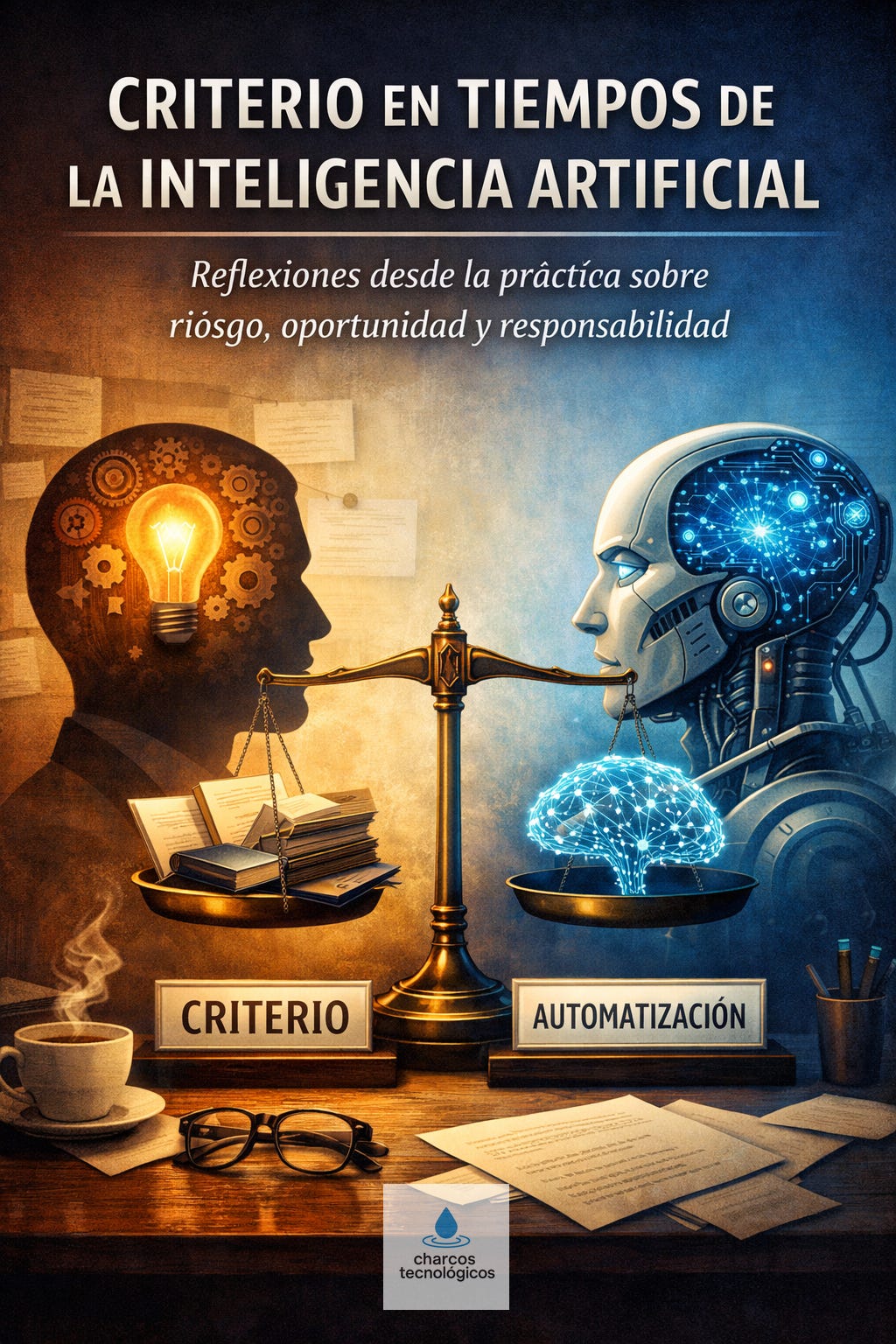
Image generated with ChatGPT.
I never imagined that this year would be as exciting as it is difficult to close. This December, we have billed four times more than in the same period of 2024, something paradoxical at a time when it seemed that AI would leave many behind.
It has been an intense year for several reasons. We have closed three projects that we still cannot announce —two of them particularly relevant at a technological and human level—, we maintain our historical clients, with an average of five years of retention, and we have added new accounts.
Additionally, we have consolidated our position within the development with artificial intelligence. Not despite AI, but precisely because we have treated it as what it is: a powerful tool, but never a substitute for judgment or responsibility.
🕒 Summary for busy people
Estimated reading time for the full article: 6–7 minutes.
Artificial intelligence is both a real risk and a huge opportunity. Not because it will replace us, but because it accelerates tasks while exposing something that cannot be replaced: human judgment.
Value is no longer just about executing quickly, but about planning better, choosing more carefully, formulating problems well, and supervising responsibly. AI amplifies capabilities, but also errors, and delegating without control can be as dangerous as not using it.
In this new scenario, the true differentiator will not be who uses more AI, but who knows when to use it, when to stop, and when to say “this does not go into production.” Judgment and will remain our last bastion.
AI: Risk or opportunity?
Both. It is a huge risk. Not only because we are dealing with a technology that is often opaque and has immense potential, but also because it will displace, if not directly replace, entire jobs. And not just a few: many.
But it is also an opportunity. These changes challenge us to do things differently. It’s not that execution has stopped being important, but planning, judgment, and purpose now take on superlative relevance.
From what I have been able to observe on the ground, AI is streamlining many tasks, democratizing others, and allowing us to prototype faster and test multiple paths at the same time. But as we already know, it lacks judgment. It is absurd to expect it to replace us in critical or supervisory tasks.
The agent fever, in which we were going to stop responding to emails and attending meetings, was an idea from someone easily impressed by magic tricks.
Agents are great, but be very careful with them. They can disrupt critical functionalities that, if it weren’t for version control in git, would blow up an entire project. The difference is not in whether to use them or not, but in knowing when to delegate and when to assume that responsibility remains human. Although if it weren’t for them, a project like my talkative CV would have been left in a drawer for lack of time.
What uses will consolidate?
Here I speak one hundred percent from my feelings. I believe that once all the dust that has been raised in recent months settles and it is shown that there was more noise than signal, we will be able to identify the uses that will generate more momentum.
We will experiment more
The ability to run tests and prototypes faster, combined with cost reduction, opens the door to a rise in experimentation. Here I recommend doing things thoughtfully and setting a limit. It makes no sense for side-projects or immature ideas to end up taking time away from established projects.
We will plan more deeply
I have the feeling that having tools that can execute a wide variety of intellectual tasks more or less well will free us to think and plan more deeply. However, we must be careful because, following the previous paragraph, as we increase our bandwidth, we may fall into the temptation to accelerate without brakes.
We will be more selective
I think the key will be in those who can be selective and focus their vision on building useful and excellent products. Nothing new under the sun, although it becomes important now that many more people will throw themselves into launching products and services en masse.
Beware of juniors
We are already seeing that juniors may find their entry into companies threatened because the tasks that are normally assigned to them are being taken over by machines. We must make an effort to ensure that less experienced profiles have their place in companies; otherwise, in the long term, there will be no one to fill higher responsibility positions.
If we break the learning chain now, in a few years we will wonder why no one knows how to make complex decisions.
Value will shift again
For a time, it will seem that everything is worth the same: texts, code, designs, ideas. But value does not disappear; it shifts. It will concentrate again on those who know how to formulate problems well, not just on those who can solve them quickly.
The difference will be in supervision
Those who delegate the most to AI will not win, but those who supervise it best. The ability to review, question, and say “this does not go into production” will be more valuable than ever, even if it does not show up in demos or benchmarks.
Judgment and will
If there is something we still preserve as an exclusive treasure, it is judgment and will. Without it, we would be mere automatons.
Today, more than ever, we must cultivate them to continue steering our destiny. How to achieve this? It is very easy and at the same time very costly. We have to ask incisive questions; not settle for the first answer or the easy solution; question what could be controversial or have multiple viewpoints; refer to sources whenever possible; and of course, give value to everything that makes us human.
None of this guarantees that we will all keep our jobs, because technological changes are unpredictable, but without all that we would have given up too soon. And I don’t know about you, but I have always placed a high value on my existence.