Image generated with ChatGPT. There is a scene that has been repeating too much lately. A project meeting with the business team, the product team, a couple of developers, and someone from data. Everyone speaks with admirable confidence: “Model,” “agent,” “context,” “fine-tuning,” “RAG,” “tokens,” “reasoning layer”…
And yet, if you were to ask what exactly each of those words means, you would get at least five different definitions.
We all want to be in the game, but it seems we are playing by different rules. And then we are surprised that projects get stuck, that expectations crumble, or that a half-hour meeting turns into a linguistic therapy session. And above all, we complain about the hype.
In our rush, we have forgotten the rigor necessary to establish a common understanding, and above all, to understand each other beyond the trendy technicalities.
🕒 Summary for busy people
Estimated reading time for the full article: 7 minutes.
Most artificial intelligence projects do not fail due to technical issues, but because teams do not speak the same language. “Model,” “agent,” “RAG,” or “context” mean different things to business, product, and development, and without a common language, chaos is guaranteed.
GlossarIA was created to bring order to that noise: a living, open, and collaborative glossary that defines the essential concepts of AI clearly, practically, and updated. It is built on GitHub, maintained in CSV, and published on a minimalist website with a bilingual version.
It does not aim to be encyclopedic, but useful. The important thing is to understand each other. Because without language, there is no consensus; without consensus, there is no strategy; and without strategy, there is no project.
GlossarIA does not solve AI: it solves how we talk about it. And that, today, is already a revolution.
A glossary is not enough
I have been working for months with clients who are seriously incorporating AI. Entire teams trying to decide what to build, how to integrate it, what to expect from the system… and, above all, trying to understand each other. Spoiler: they do not always succeed.
The difficulty does not lie in the code or the models. It lies in something much more basic: we do not share the same vocabulary.
Traditional glossaries do not help. They are static, academic, and often abstract. And what is correct today may not be in four months. AI evolves too quickly to keep using definitions from two years ago… or even two weeks ago.
That’s why, some time ago, I started thinking about an idea:
What if there were a living, bilingual glossary, continuously updated and designed for real teams within real companies? A glossary that belonged to no one, precisely so that it could belong to everyone.
From that thought, GlossarIA was born.
What is GlossarIA and what makes it different
GlossarIA is not a pretty PDF with definitions. It is a lightweight infrastructure designed so that anyone can understand AI without wasting time or falling into misunderstandings.
The pieces are very simple, but together they allow for something powerful:
1. A “source of truth” in CSV format
Yes, a CSV. Readable, lightweight, editable, and versionable.
2. Public repository on GitHub
Anyone can propose new terms, suggest improvements, or report errors via Pull Requests.
3. A website built with Astro
Fast, minimalist, and functional: search engine, filters, detailed view, and language switch.
GlossarIA does not aim to be exhaustive. It aims to be useful. The definitions are brief, clear, and oriented to the real world. No smoke, no hype, and no unnecessary technicalities. Something you can take to a meeting tomorrow and that will help you work better.
Why this matters to companies
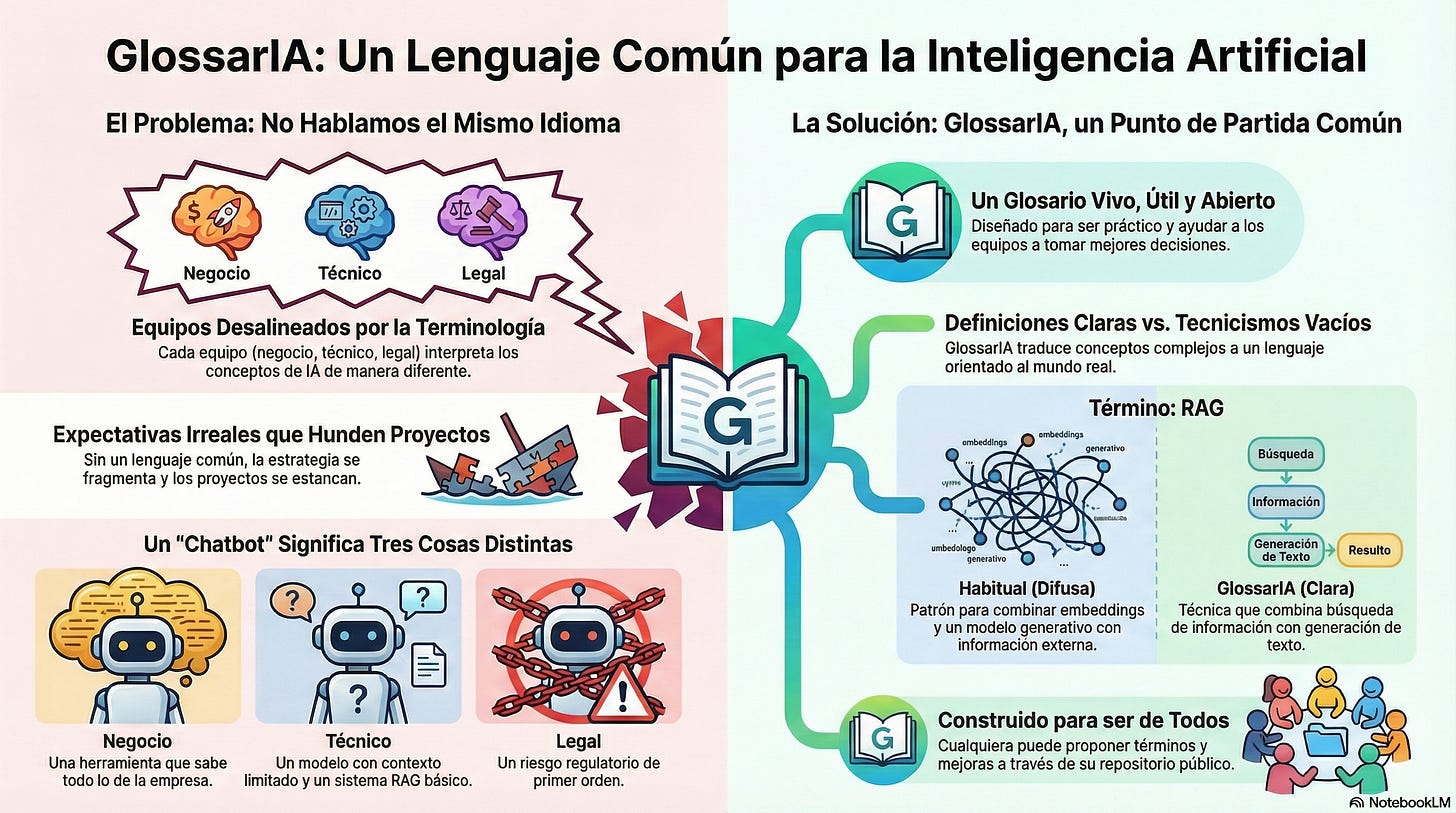
Image generated with NotebookLM. AI is reconfiguring how we work, but most tensions in projects do not come from technical limitations. They come from misaligned expectations.
A simple example:
- For a business team, “building a chatbot” may mean “a tool that knows everything the company knows.”
- For a technician, it may mean “a model with limited context and a basic RAG system.”
- For the legal team, it may mean “a top-tier regulatory risk.”
And here we are, three teams using the same word to refer to three completely different realities.
GlossarIA does not solve AI. GlossarIA solves how we talk about AI. And that, paradoxically, is what allows projects to move forward.
It doesn’t matter if you are a CEO, a marketing manager, a product manager, or a lead developer. If you do not share the language, you will not share the strategy.
How it has been built
The methodology is simple: clear definitions, practical examples, an explicit business orientation, and zero unnecessary noise. We do not seek hype or empty technicalities, but concepts that truly help in decision-making.
And, above all, a mechanism in which anyone in the world can participate to keep it alive.
Examples: before and after
RAG
Common vague definition: “Pattern for combining embeddings and a generative model with external information.”
GlossarIA definition: “Technique that combines information retrieval with text generation.”
Agent
Common vague definition: “A model that acts autonomously.”
GlossarIA definition: “Model or system that chains actions to execute complex tasks with little human supervision.”
Context
Common vague definition: “The information that the model takes into account.”
GlossarIA definition: “Additional information provided to the model (usually at the start of the conversation or in the system prompt) so that it understands the role, domain, rules, or specific reality in which it must operate.”
How you can participate
GlossarIA is open. You do not need to know how to code. You do not need to be an AI expert.
You can:
- Suggest a new term.
- Report a confusing definition.
- Point out an obsolete concept.
- Submit better examples.
All through Pull Requests or Issues on GitHub. And we have a form to assist you in the process.
Language as a link and not as a barrier
AI is advancing quickly, very quickly, but its speed is not the problem. The problem is that we do not share the language to talk about it.
Without language, there is no consensus. Without consensus, there is no strategy. And without strategy, there is no project.
GlossarIA does not intend to be the final word on AI. It aims to be the common starting point for diverse teams to talk about the same thing when they think they are talking about the same thing.
A small compass to navigate through the noise.
And the best part: it is just getting started.