Image generated with ChatGPT. The youth of the 50s grew up with the fear of war; before them, the fear was of not having bread to put on the table. Ours seem to have a much less concrete but equally terrible fear: the fear of being late. Late to have their own home. Late to have a quality job. Late to live their own life.
Our children live amidst constant noise. A deafening noise that, in many cases, is deafening. A noise made of haste, immediacy, and incessant comparison, all adorned with the feeling that it has expired before they even understand it. There is a generation that saw the beginning of their youth cut short by COVID, learning too early that uncertainty also brings us lessons.
And just when it seemed they were starting to orient themselves, artificial intelligence appeared, that new silent goddess that promises to make everything easier while forcing us to rethink even the smallest details. And it seems to tell the kids: “Why bother, when I can handle everything?”
Never before have we had a tool capable of imitating human thought so accurately, nor an era so obsessed with measuring it and boasting about it. The result is paradoxical: a hyperconnected generation that is increasingly alone; informed and infoxicated; educated but without a place to apply what they have learned.
And it’s not their fault. We have handed them a world where paths are updated faster than maps. And the worst part is that we no longer even know if we still have a compass.
🛈 This text is part of a chain of authors reflecting on how to support the next generations.
I was invited by Mario Acevedo, to whom I thank for the opportunity to participate in this series of articles. According to the initial plan, the baton should have been passed to Salvador Lorca 📚, but I believe the last author to participate, unless I’m mistaken, was CS Bermejo. And the next one, according to the order I was given at the time, will be Carol from Bienestar Integral Contracorriente | Mujer Pluma. You can read the first article in the series here.
We are facing a conversation that is as fascinating as it is necessary. If you are young, a parent, a teacher, a philosopher, a bit of everything, or simply someone concerned about these issues, spread this series of articles and help us by sharing your perspective and proposals.
🕒 Summary for busy people
Estimated reading time for the full article: 5 minutes.
We cannot prepare young people for a future that we cannot even imagine, but we can teach them to keep the human compass while they learn to use technology.
The challenge is not to master artificial intelligence, but to continue being human while we use it: to remember that behind every screen there are stories, decisions, and consequences. The tools will change, but the values with which they are used will make the difference.
More than a manual, we must leave them an intergenerational pact: to accompany them, listen, and learn together. Above providing answers, let us help them formulate the right questions.
What can young people do?
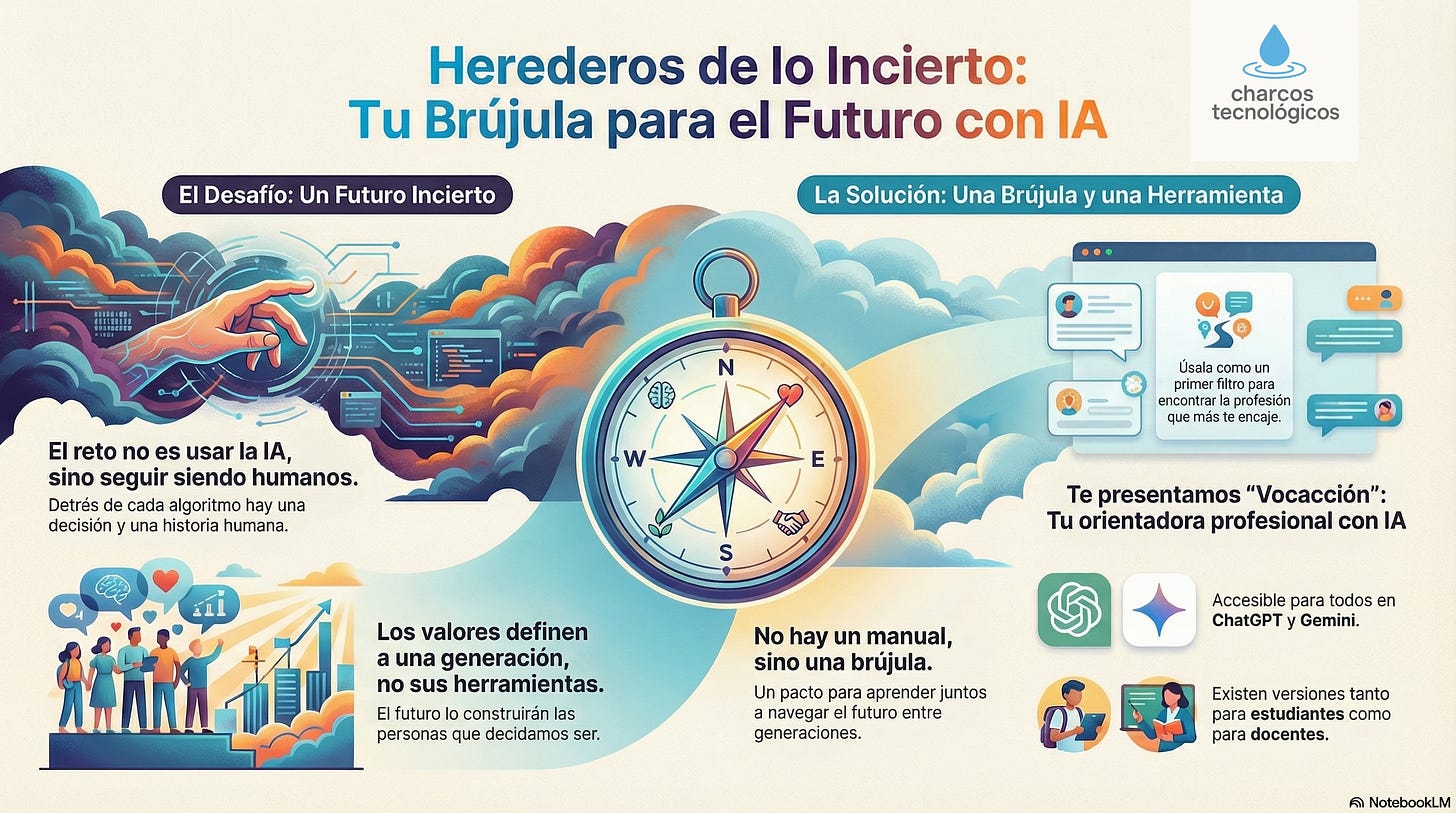
Image generated with NotebookLM. So far, I have spoken as a parent. Now I want to talk to you as someone who was also young and felt lost. I’m going to completely change my tone and sit among you, even though I have gray hair. I do not intend to be condescending or to seem cool, or whatever it’s called now. My only intention is to offer you the little clarity that comes from having walked a bit further than you, and not because I am better, but because I started walking earlier.
The first thing I advise you is not to try to compete with machines. I have said before that it makes no sense to compete in doing sums with a calculator or to memorize everything that a database can store.
Instead of thinking faster, why not strive to think more deeply and with more purpose? No matter how much you are ridiculed with caricatures of lazy and empty people, you are particularly good at this. And you are because, like all generations, you have a natural drive for conquest, but unlike all others, you have a greater hunger to prove your worth in a world that does not seem to accept you.
AI may be more prolific at writing or generating code, but by its very nature, it is not more authentic. The realm of feeling, decision, and mistake still belongs to you. Learning to coexist with imperfection will be a more valuable skill than mastering a language model.
Young people have the right not to know yet who they are. And in an era that demands you have a plan at 16, two degrees, three languages, and a master’s before 30, claiming the right to doubt is almost an act of resistance.
Claim your future, create your path!
Those of you who will occupy decision-making positions, do not forget how important it is to care for all generations, both those who have already fulfilled their time and those who want to prove their commitment.
But let’s not be mistaken. AI has come to stay, and using it does not mean surrendering, but understanding its biases and limits. You will have to get used to maintaining a dialogue with machines. And if you want it to benefit you, you will need to develop six skills that are not learned on TikTok:
- Critical spirit, to distinguish the useful from the unnecessary and the true from the false.
- Continuous learning, to keep developing skills in a world where changes will accelerate without brakes.
- Compassion and empathy, the qualities that define what it means to be human.
- Proactivity, to not delegate the important to machines, to continue making decisions, and to not let yourselves be enslaved by the comfort of having everything done for you.
- Transversality in the humanistic sense. Now, the big picture is as important as execution.
- A sense of community, essential at a time when technology can isolate us. Human beings are social beings, now and in thousands of years.
- Resilience, to maintain course even when the ground shifts beneath your feet. You don’t have to endure everything, just learn to bend without breaking, adapt without losing the sense of who you are. Life, especially in this unpredictable era, rewards those who know how to get back up more than those who never fall.
What can the system do?
The educational, political, and economic system remains anchored in a version of the world that no longer exists. We train you for professions that will disappear before you finish your degree and then blame you for not adapting. That narrative is as cruel as it is useless.
We need an education that rewards curiosity and critical thinking, not memorization or immediate performance. That teaches how to coexist with ambiguity, solve real problems, and ask better questions. And that includes technological ethics as a transversal subject, not as a footnote in election rallies.
The system must also guarantee minimum material conditions: housing, equitable access to technology, and time to live. We cannot ask a generation to innovate when they can barely survive. We cannot demand hope without offering stability.
AI can be an ally in all this if used well, for example by personalizing education, automating bureaucracy, reducing administrative burdens, or expanding access to resources. But it will not be as long as the focus is solely on productivity and not on well-being.
The paradigm shift will be more cultural than technical. We need to move from the logic of faster to that of more human. And this, although it requires political decisions, will only become real if you demand it. Take the reins. Raise your voice and demand what is just. Do not wait for it to be given to you, because their interests may not align with yours, and each one has the responsibility to create the world they want to live in.
What can adults do?
Our task is not so much to provide answers as to accompany in the search. I believe it is more important to be credible than to seem infallible. To show that we also doubt, that we also sometimes feel out of place in front of this new intelligence that mimics us.
We can help you by listening without irony, without judgment, remembering how it hurt not to be taken seriously.
We can share our limitations without fear of losing authority, because that teaches more than any moral speech.
And above all, we can transmit values that technology does not understand: patience, empathy, silence, and attention.
Educating today requires preparing you for a world that even we will not fully understand. And that implies admitting that the future, far from being a straight line, will be a blend of possibilities where what matters, above answers, will be having clarity on what we must question.
An intergenerational pact
Perhaps the real challenge is not to teach you how to use AI, but to continue being human while you use it. To remember that behind every screen there is a story, behind every algorithm there is a decision, and behind every mistake there is an opportunity to learn together.
We do not know what the future will be like, but we can decide what kind of people we want to build it. Because what has always defined a generation, above the tools it inherits, are the values with which it decides to use them.
We are not going to leave you a manual. We are going to give you a compass and we are going to sit with you, as has always been done, so that we can learn to use it together.
Bonus: A free resource for you
Image generated with ChatGPT. Staying with mere words is comfortable for me. I write this and move on to something else. Unfortunately, my time is limited, but I can use technology for the benefit of all and thus, as a bonus, give you a practical example of what we have talked about.
I have built Vocacción, a career guidance tool that will help you find the profession that suits you best. Use it as a first filter, knowing that none of these tools can replace the advice of a professional in career guidance. I have created it both in ChatGPT and in Gemini to make it more accessible.
🧠 ChatGPT
- Vocacción: https://chatgpt.com/g/g-691381d5ff0481918fb4bf16eb759e42-vocaccion
- Vocacción Docentes: https://chatgpt.com/g/g-69138df11f188191a24f2ac14a56bc06-vocaccion-docentes