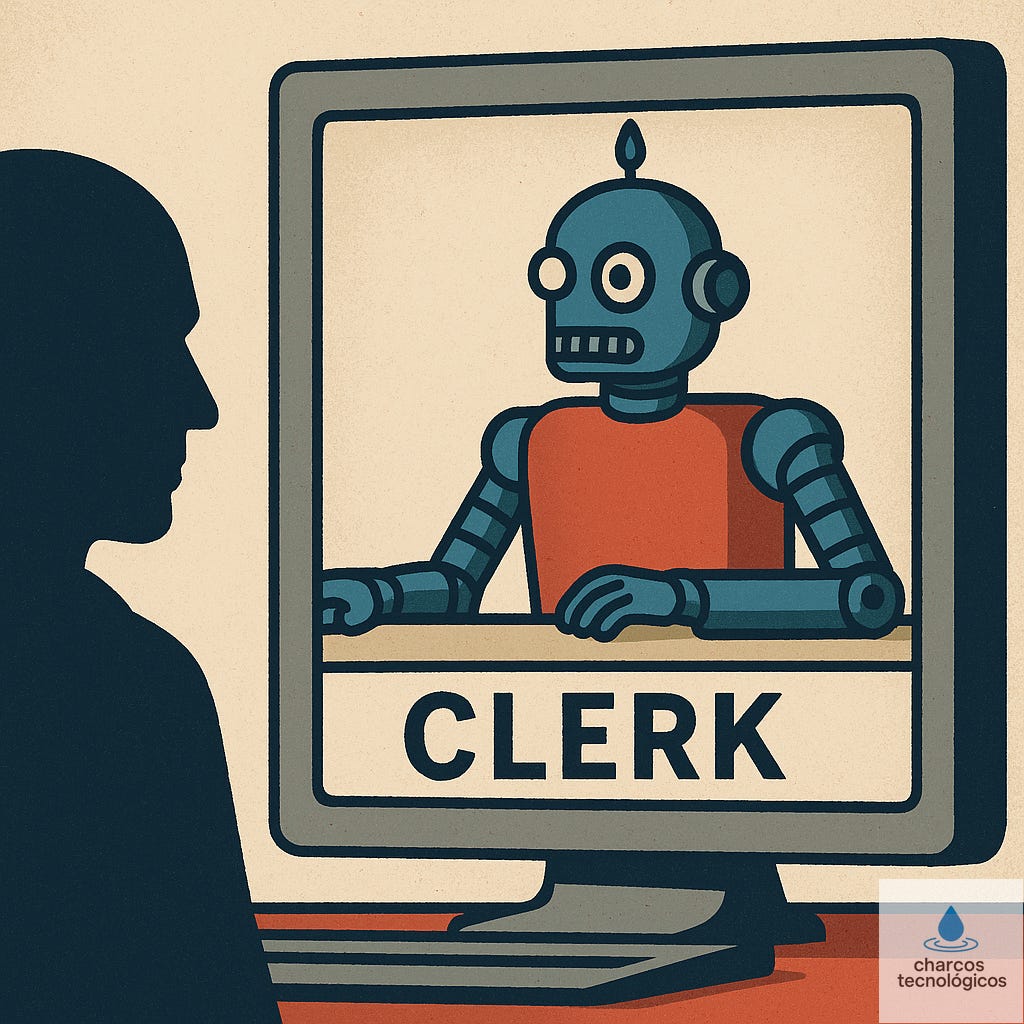
Image generated with ChatGPT
If you stopped going to your company tomorrow, would anyone notice immediately? Or would it take days for someone to ask about you?
Goldman Sachs estimates that between 6% and 7% of workers in the United States could lose their jobs if artificial intelligence is adopted on a large scale.
What if that percentage were higher in your sector? What if, instead of entire jobs, small parts of your work gradually fell into the hands of machines?
🕒 Summary for busy people
Estimated reading time for the full article: 8 minutes.
Artificial intelligence is starting to take over parts of our jobs. It doesn’t always completely replace people, but it chips away at small tasks until one day we realize we are doing less than we used to.
It’s not easy to stay calm amidst so much noise. We are sold certainties when what exists are doubts: that we need to learn to program, that creativity will save us, that empathy will be the new oil… But while we repeat these mantras, LLMs are already programming, designing, and even listening better than we do.
I integrate AI into almost everything I do, I haven’t lost collaborators, and I’ve gained time. But I still don’t know if that free time is a gift or a trap. Infinite productivity sounds good until you discover it can also be a form of exhaustion disguised as efficiency.
Perhaps the important question is not what we do, but how we do it. In a world that automates every gesture, the only thing that remains ours is purpose. And there, at least for now, we still have an advantage over machines.
Infinite doubts, scarce certainties
I often wonder what will become of my profession in the coming years. It’s hard to abstract from the doomsayers who, day in and day out, proclaim that we will all be out of work. I don’t know if they have another skill, but they cultivate the impostor syndrome like no one else.
I’ve been experimenting with AI for a while, long before it became fashionable to talk about ChatGPT (back then we called it NLP, NLU…). Today I have models integrated into almost all my processes. And I can say that they help me be more productive.
Will we end up being replaced? I don’t dare to predict that. Very sensible people who are in the field, like Julio Prieto from Digital Bakers, are optimistic about this.
I, like Fox Mulder, want to believe, but I still have doubts. So what started as an exercise in futurism has ended up as a list of open questions to invite reflection. Something that, at least for now, we still do better than our beloved machines.
The gurus who swapped Python for PowerPoint
In recent years, it has been repeated like a mantra that you had to learn to program even if you worked in library science. The argument was that not knowing how to program would become the new illiteracy.
Is it really essential? Now that LLMs generate code and even test it on their own, does it make sense to invest years in learning a skill that the machine itself is automating?
Moreover: did all those who preached the need to learn to program actually do it… or did they simply switch hats, first to blockchain and now to “AI consultants”? Spoiler: few signed up for Python classes.
There has also been much talk about the importance of cultivating creativity. Setting aside the complex question of whether LLMs can be creative, can we all really be creative? Do we train to be creative? Do we all have the talent to be so? And assuming we do, does it make sense to compete with tools that are much faster and cheaper than us?
“We need to be more empathetic,” they said while therapeutic consultations with ChatGPT skyrocketed during the pandemic (Popularity of Mental Health Chatbots Grows, 2022). Isn’t it ironic that we turn to empathy as a safe refuge when we feel threatened? Machines could tell us: “Better late than never.”
Perhaps it’s not about universal recipes. Could it be that the risk is not in what you do, but in how you do it?
Integrating LLMs into my processes has not, for now, led me to dispense with any collaborator or supplier. On the contrary, it is allowing me to cover more because I save hours on tasks that did not add value.
Now, does this have a time horizon? How long will I continue to add value in a scenario where technology is becoming increasingly capable?
Infinite productivity: advancement or condemnation?
AI promises to save hours of work (sometimes too many). We find ourselves taking on high-value tasks, as if each of us were the Elon Musk of our field.
What truth is there in this? Do we invest that recovered time in learning or producing more, or will we fall into the arms of procrastination?
Does it make sense to always want to be at the peak of productivity? Several studies have shown that boredom stimulates creativity. Psychologist Sandi Mann from the University of Central Lancashire argues that constant activity kills boredom, and therefore creativity.
Do we really want to give up those dead moments that allow us to think differently?
Wouldn’t it make more sense to reorganize what we do, how we do it, and imbue it with something that only we can understand? I mean purpose.
If there’s one thing new generations seek, it’s meaning in what they do. And although we don’t always have it clear, it seems evident that in this we still have an advantage over machines.
Between hope and paralysis
As with all technological advances (I resist calling it a revolution), this stage awakens desires and fears. There will be those who adapt and those who will be left behind. The sad thing is that we still haven’t learned to minimize unemployment during waves of transformation. Of course, some resist evolving. But there are also those who simply cannot.
Meanwhile, we live in unprecedented acceleration. Daily advances, new tools, professions invented on the fly… and a growing sense of exhaustion. Information overload leaves us paralyzed.
Do we need to know everything, try everything, be everywhere? Or is it enough to learn on the go, adapting without trying to control everything?
As Bruce Lee said in that ad that has become a mantra: Be water, my friend.
Reply
Do you want to read the reply to this article? Click here:
🚀 Weekly reflections like this in your inbox. Subscribe to Charcos Tecnológicos
References
- Goldman Sachs (2023). How Will AI Affect the Global Workforce? goldmansachs.com
- Julio Prieto (2025). The Great Failed Experiment: When Silicon Valley Bet Everything on AI. LinkedIn
- Nick Zagorski (2022). Popularity of Mental Health Chatbots Grows. psychiatryonline.org
- Isabel Fosler (2024). Why Boredom Might be Your Best Creative Tool. The Communicator
Thank you for reading Charcos Tecnológicos! Subscribe for free to receive new posts and support my work.