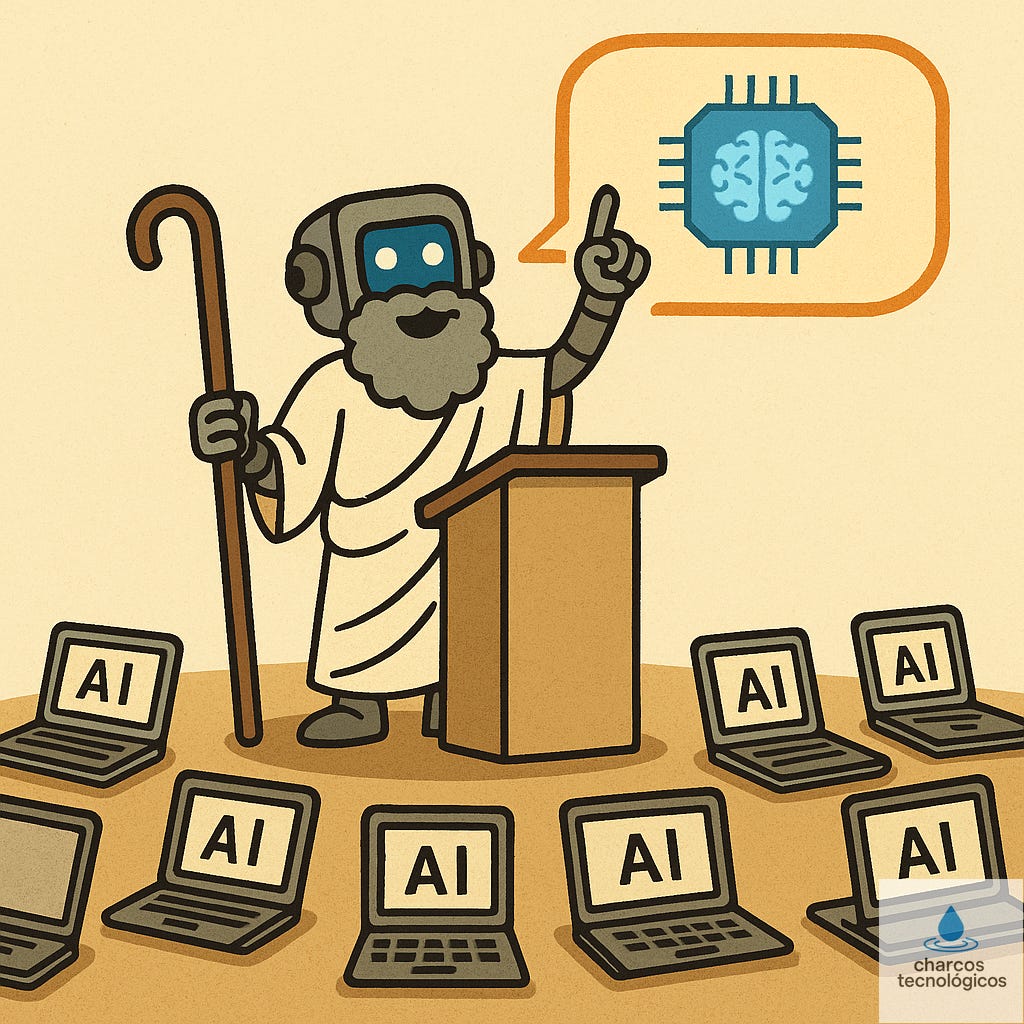
Image generated with ChatGPT. A few months ago, a friend of mine wrote to me. One of those who can’t tell the difference between RAM and disk space, but suddenly becomes a tech expert because they’ve read a couple of articles on Xataka. He told me:
“You have to try this, it’s crazy.”
“This” was ChatGPT.
Like everyone else, the first thing he did was ask it to tell him a joke. Then he asked it to write a love poem in Alexandrine verse, but dedicated to his dog. The result was cheesy enough for him to believe he had discovered the digital reincarnation of Pablo Neruda.
I smiled, of course. Because for those of us who have been watching technological trends for twenty years, this scene sounds all too familiar.
Do you like these reflections? Subscribe for free to Charcos Tecnológicos
🕒 Summary for busy people
Estimated reading time for the full article: 7 minutes.
Generative AI has become the new technological religion. It promises miracles, inspires devotion, and fills headlines, but behind the fervor, there’s a lot of déjà vu. We’ve seen this before with .coms, blockchain, NFTs, or the metaverse: promises of revolution that ended up in smoke… and some real utility.
It’s not about denying its value; writing, programming, analyzing data, or creating content has never been easier, but about recognizing the danger of turning it into dogma. When faith replaces critical thinking, the prophets of hype appear, along with miraculous courses and companies selling the same old thing with the AI-powered sticker.
I prefer to understand it for what it is: a tool. In good hands, it amplifies creativity and saves time. In bad hands, it feeds impossible expectations. The key is to use it without kneeling before it.
This isn’t the first time we’ve been sold miracles
Don’t get me wrong: generative AI is useful, powerful, and transformative in many contexts. But the way society is embracing it has more of a religion than a technology vibe.
- Blockchain was going to end banks. Result: happy banks, ruined savers.
- Second Life was going to replace real life. Result: today it’s nostalgic material for 90s forums.
- NFTs were going to be the future of art. Result: jpegs of monkeys selling for garage sale prices.
- The Metaverse was going to be the new Internet. Result: a handful of avatars with poorly animated legs and Mark Zuckerberg giving talks in empty worlds.
And now, generative AI is presented as the universal panacea.
The narrative is identical:
- A group of gurus announces that “this will change the world.”
- The press repeats the message as if it were the Ten Commandments.
- Companies rush to put the magic word in their PowerPoint to avoid looking like dinosaurs.
- Investors hand out money as if they were printing bills in the office copier.
The religion of AI
The comparison with religion is not unfounded. Generative AI has created its own rituals and symbols.
- The prophets: Sam Altman, Demis Hassabis, Dario Amodei.
- The scriptures: papers and posts on arXiv that almost nobody understands, but are cited as if they were verses.
- The miracles: spectacular demos that seem like magic.
- The liturgy: prompt engineering courses that resemble catechism for initiates.
- The faith: people convinced that in five years there will be no programmers, lawyers, or doctors, because the machine will do it all.
The tech community is divided between fervent apostles and skeptical heretics. And in the middle are the veterans, who look on with a raised eyebrow and think:
“I’ve seen this before in 1999, 2012, 2017…”
👋 If you’re enjoying this, remember that I publish something similar every week.
The financial bubble disguised as innovation
When something becomes a religion, logic stops mattering. Faith matters. And in the startup world, faith is measured in millions of dollars.
Suddenly, every product carries the label “AI-powered.”
- A pizza ordering app? AI-powered pizza recommendations.
- A mediocre CRM? AI-powered customer insights.
- An Excel sheet with macros? AI spreadsheet assistant.
What was once a boring product is now dressed in miracles thanks to three magical letters: AI.
What generative AI actually contributes
Up to this point, the critique. But let’s be fair: generative AI is not just smoke.
- Assisted writing: from emails to reports.
- Assisted programming: GitHub Copilot, Cursor, or Junie (the one I’m using right now) save hours of work.
- Data analysis: segmenting information has never been so accessible.
- Augmented creativity: designers and writers now have an assistant.
The key is to understand AI as a tool, not as a messiah.
For example, here are three of my own creations:
- Vinicio, a virtual sommelier that recommends pairings, generates recipes, and creates tasting notes for many wines. It has limitations, of course. Sometimes it tells you a wine doesn’t exist when you have the bottle in front of you, but that’s the point: technology will never be perfect.
- CodeCV, an open-source tool that uses LLMs to generate a CV from git repositories. For a programmer, it’s very useful to get a natural language summary of all the contributions made to a project and saves a lot of time, because sometimes one doesn’t even remember exactly what they did.
- BugOracle, another open-source tool that relies on LLMs to analyze issues, search for patterns, and generate actionable summaries.
The limits and risks
- Hallucinations: AI lies with the confidence of a politician on the campaign trail.
- Biases: if you train a model with garbage, you get amplified garbage. For example, if you ask an LLM for an image of a left-handed person, it often shows a right-handed person because most images of people writing use the right hand. Or if you try to obtain an analog clock showing a time other than what catalog clocks usually display.
- Energy cost: training and operating models consumes obscene levels of electricity.
- Oligopolies: OpenAI, Anthropic, Google, Meta, Mistral… five companies controlling how the world’s knowledge is processed.
The déjà vu: history repeating itself
Every decade has its hype:
- 1999: Internet and .coms.
- 2012: Big Data, “the new oil.”
- 2017: blockchain.
- 2021: NFTs and the metaverse.
- 2023–2025: generative AI.
Will it disappear? No. Will the bubble burst? Yes, but what’s useful will remain.
Conclusion: of bubbles and religions
The question isn’t whether generative AI is a bubble or a religion. The question is how we use it.
- If we treat it as religion, we’ll end up praying to an oracle that will give us false but convincing answers.
- If we treat it as a bubble, we’ll invest blindly and cry when it bursts.
- If we treat it as a tool, we can harness its real potential without losing our heads.
As for me, I’ll keep watching my friend ask for poems for his dog. And I’ll keep smiling. Because behind every new technological religion, the only thing that doesn’t change is the same old thing: our infinite capacity to believe in digital miracles.
🚀 Weekly reflections like this in your inbox. Subscribe to Charcos Tecnológicos.