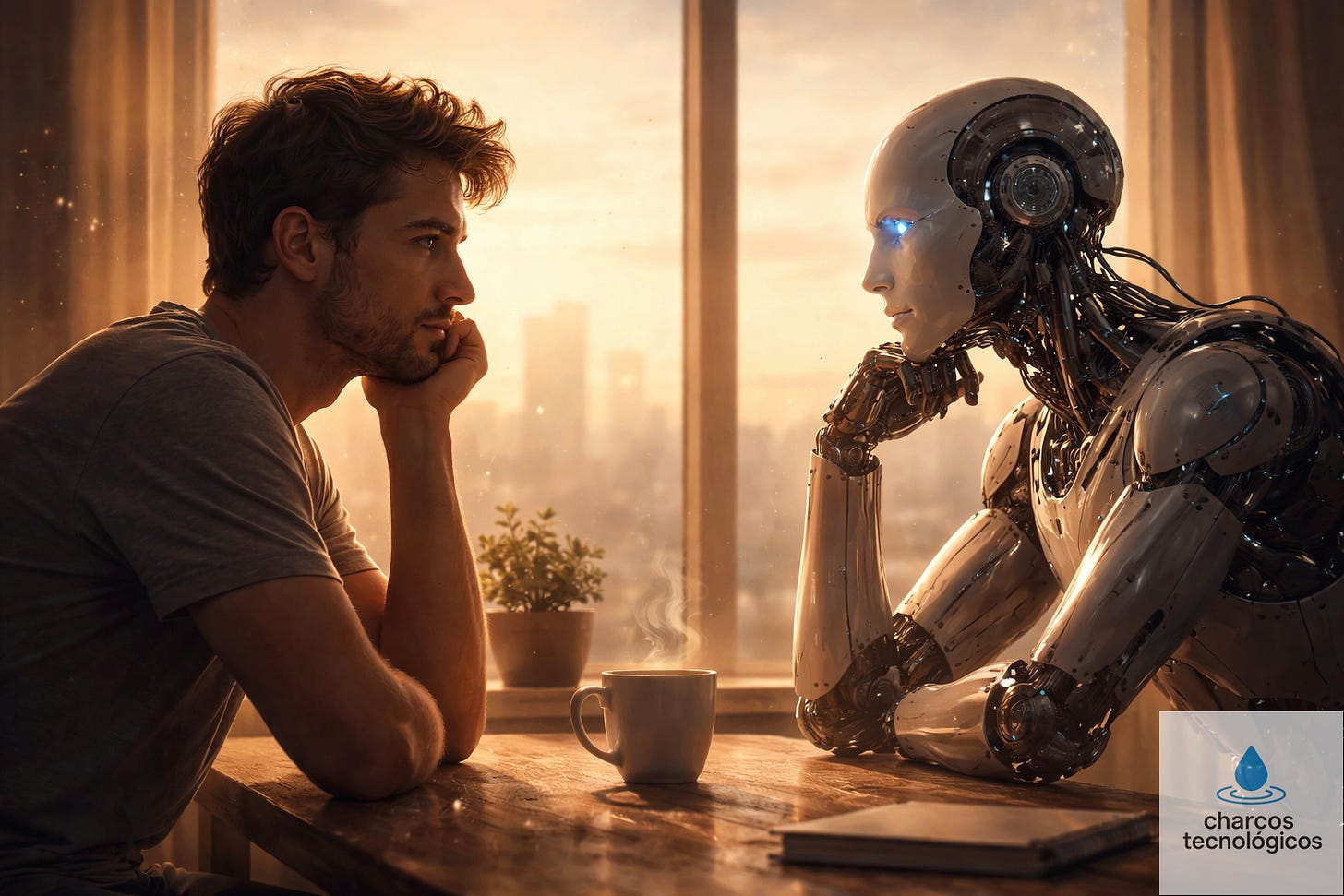
Image generated with ChatGPT.
Many of us wonder what differentiates us from machines. At first glance, this may seem like an absurd question. Everything, right? And yes, everything or almost everything. But we increasingly feel that it is less so, because as I have argued before, our refuge as human beings is the mind. And since we have memory, no other living being has posed the slightest threat or competition in that realm. Until now.
Because yes, they are powerful statistical machines without real reasoning ability, without judgment, without intention or will. But deep down, they unsettle us. We, who are capable of intuition, suspicion, and distrust, sense something that bothers us behind that mask of neatly filtered data.
So, returning to the initial question, what differentiates us from machines? Is it our morality? Is it judgment? Intuition? Will? The fear of death? Yes, all of that undoubtedly sets us apart. But I believe there is something that separates us in a much deeper, perhaps insurmountable way. It cannot be captured by a definition or a logical argument. It is better understood when seen. The answer is in this video, and it is offered by Matt Damon:
And here, the scene he refers to from the film The Smashing Machine.
What Damon explains is not just an anecdote about cinematic interpretation. In reality, several layers of human experience overlap in that narrative, each one more distant than the previous, but united by the same thread.
The first layer is Dwayne Johnson’s ability to empathetically synthesize two of his most traumatic life experiences in a dramatic scene. It is not an imitation of something he has seen, but a reinterpretation of another’s suffering with new codes. Johnson embodies his father, due to alcoholism, and his mother, due to fear of cancer. Covering himself with the sheet is a way to avoid shame and fear, to symbolically protect himself from something he does not want to face.
The second layer is Matt Damon’s ability to be moved by that story. We do not know if he has had similar experiences, whether by himself or through someone close. It does not seem so, and yet it reaches him, it touches him deeply, as if he had truly suffered that pain. Humans have the peculiarity of feeling what we have not felt through others, even if we have no prior knowledge of it.
The third layer is our capacity to be moved by the account Damon gives of his interview with Johnson. Here, the distance is vast. It is not that we have had a father with addiction or a mother diagnosed with advanced cancer; nor is it that we have seen the scene from the movie and were moved by it; it is because we share Matt Damon’s emotional perplexity towards a fictional situation based on two real situations.
All of us, as humans, are capable of feeling empathy. Of feeling compassion. Of crying for others’ tragedies. A machine cannot do that. It lacks the personal experience to understand another’s. There, in shared experience, is where our collective spirit lives and develops. There, in the mistake that stubbornly insists on becoming a success. There, in the imperfection that afflicts and redeems us at the same time. There, in the regrets for what could have been and was not.
A machine does not feel ashamed to see another machine making a fool of itself because it does not understand what it means to make a fool of oneself. A machine does not cry spontaneously when hearing a song because it cannot evoke any personal memory. A machine does not feel fear.
Still, none of this is automatic. Not everyone has to be moved. Some may find it silly; others may laugh; others may find it indifferent. Although we share codes and values, each person has a unique identity that allows them to react differently to each situation. Humans do not have a version code. We are individuals with a personality, a memory, and unique preferences.
I believe that AI has come to stay and that it will profoundly transform our world. It will take away tasks, decisions, and perhaps some certainties, whether we like it or not. Hopefully, it will also take away some noise.
But meaning cannot be delegated. No one or nothing can live for us what embarrasses us, hurts us, or moves us. Without meaning, the world is reduced to a succession of things that happen.
Let the machines organize the information. We will continue weaving stories that give it meaning.