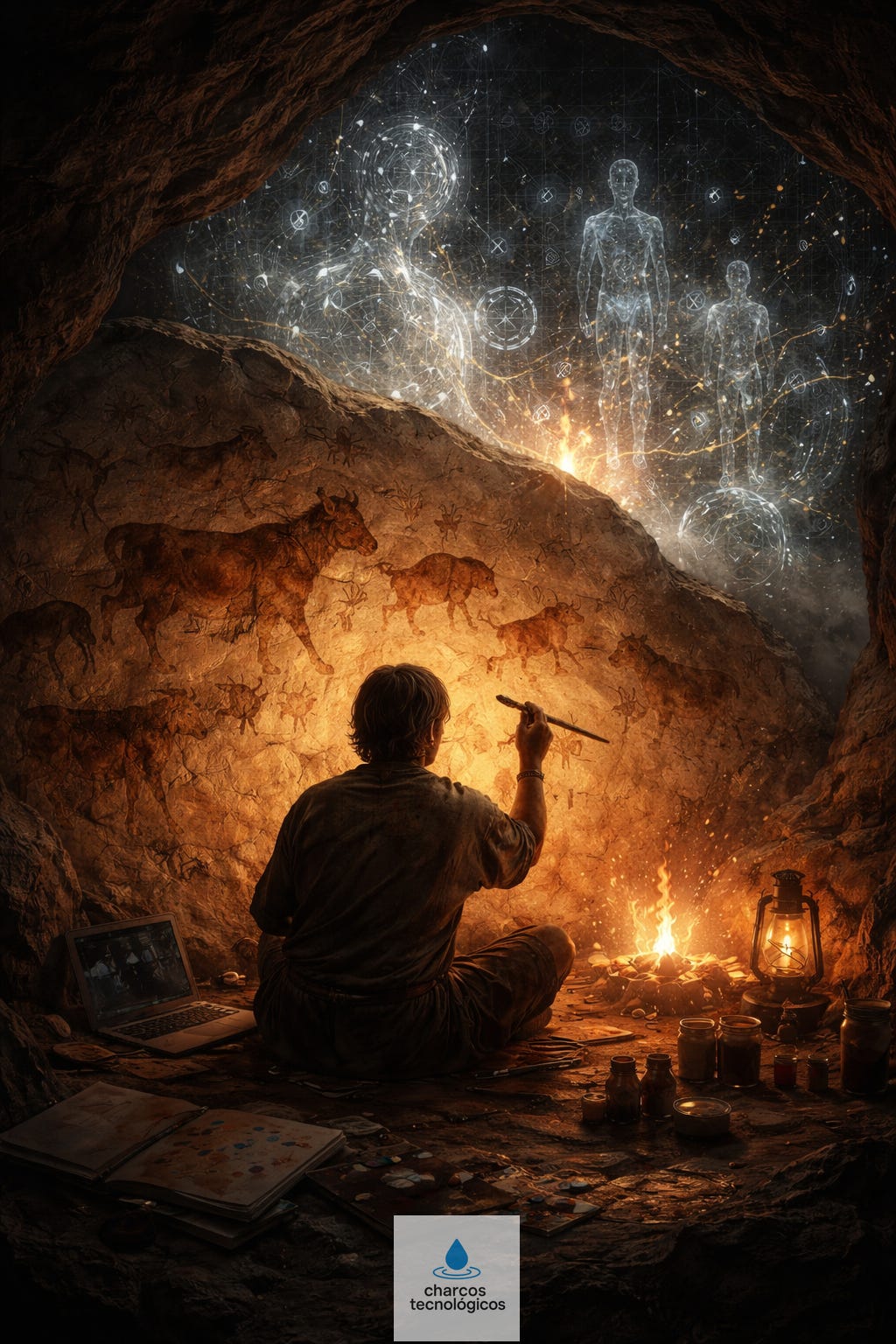
Image generated with ChatGPT.
Lately, there has been much discussion about whether machines can be creative. But every time I hear that question, another one comes to mind: Why do we create?
In a moving TED talk, Ethan Hawke suggests that creativity is not a demonstration of talent, but a tool for healing, comfort, and connection. And the more I think about it, the more sense it makes.
Most of the time, we are not concerned with creativity or art. We have enough to worry about with everyday concerns. But suddenly, one day, a loved one dies, or you experience depression, and what was once superfluous becomes essential and necessary.
Because the artist, the poet, has expressed a pain, an absence, a longing. And all of them, from the first to the last, are universal and therefore shared. We see ourselves reflected in the song, in the poem, in the painting, because its creator has captured a small part of us and expressed it in a work of art.
We do not know for certain whether cave paintings serve a practical purpose or are a reflection of primordial art. I lean towards the latter. Those people who painted on rock were amazed like us, suffered like us, and loved like us. And if that is true, artistic expression is not something we have learned, but an inherent impulse of our being.
Currently, there is an ongoing debate about whether machines can be creative or if they are limited to combining patterns to generate mere variations. Machines may be capable of generating new forms. Even surprising ones.
Still, I don’t know if an artificial intelligence could have invented cubism. Perhaps with enough data and computing power, it could do so. But the question that troubles me is another: Would the need to do so have meaning? And delving into that question, if that had happened, would we have considered it an artistic breakthrough or mere coincidence?
The question may even be simpler. If we had had LLMs in the 80s, would we have modern programming languages or would we still be using Fortran, Basic, assembly…? Would we have object-oriented programming, advanced memory management, Single Page Applications? Or would we still be using pure text interfaces?
There is no doubt that I am not impartial, and that is why I believe we would have advanced iteratively but not disruptively. In programming, as in art, as in science. Machines can be creative in a certain way. They can generate pleasant or unsettling variations. But they lack will and intuition. Therefore, we cannot expect a revolution in any field from their side. It is possible that those small iterations, those micro-advances, allow us humans to progress faster or more deeply. And there, in the combined work, may lie the key.
And here comes an essential question that may help us understand why we can create and machines cannot. If there were no people left in the world to ask machines to create a new work of art, would they do it? Would they create for themselves?
We have seen that famous social network for agents, Moltbot, which could be a Wizard of Oz, where supposed AI agents talk to each other. Has any of them, with all their raw power, felt the need to express themselves artistically? Have they created something for the mere sake of sharing it? Or are we the only ones who have the need to create to initiate that beautiful conversation that Ethan Hawke speaks of in his talk?
And yet, as I write this, I am struck by a doubt that complicates everything above. What if art does not need intention or an audience, as I have always maintained? What if beauty has no purpose? Borges recalled this by quoting Angelus Silesius: “The rose is without why”. If tomorrow an AI started generating profoundly moving works, capable of accompanying millions of people in their grief, would it matter that it has not suffered?
References
- Ethan Hawke (2020). Give yourself permission to be creative. ted.com
- Jorge Luis Borges (1963). Textos recobrados. cvc.cervantes.es