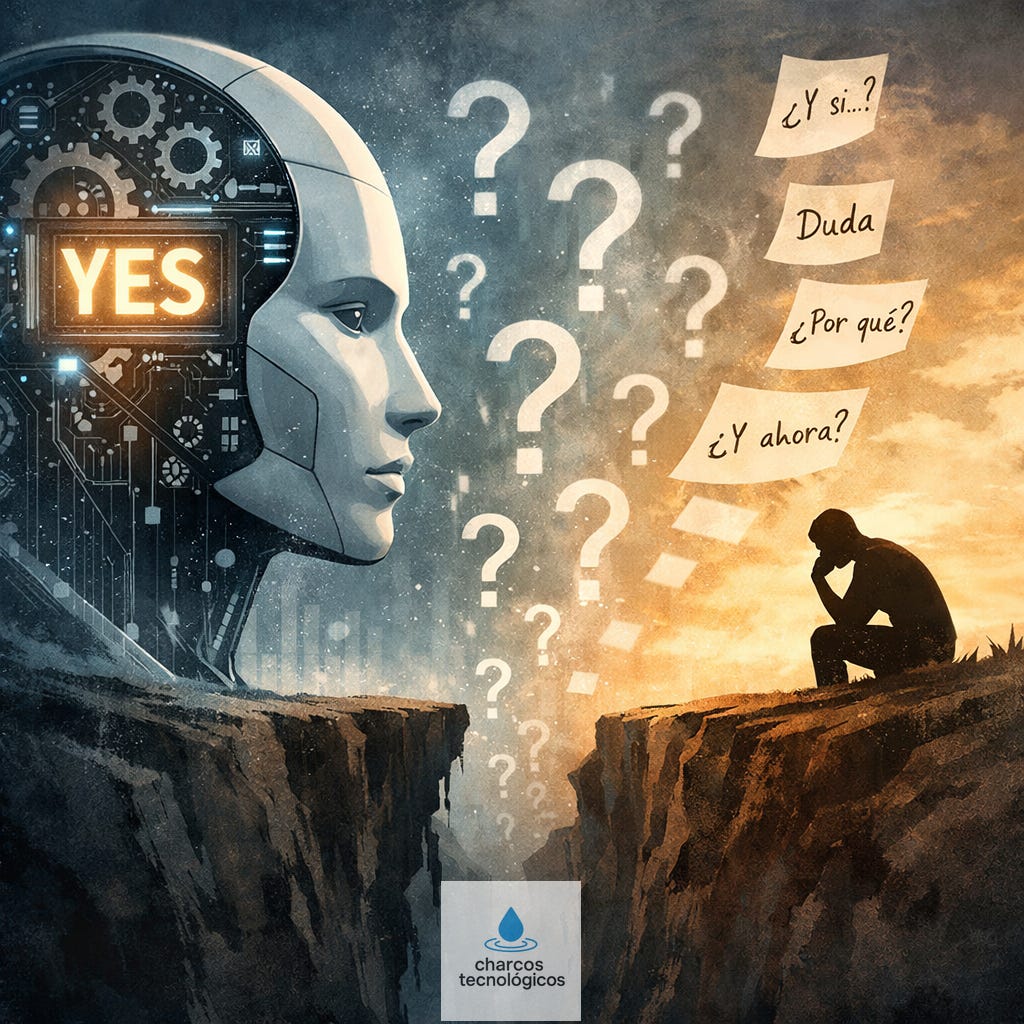
Image generated with ChatGPT
What is more interesting, a statement or a question? Would this opening be more successful if I had asserted that a doubt is more attractive than a statement? Here lies the advantage of doubt: it allows each person to choose, form their own opinion, and think critically. The statement confines; doubt expands.
Today I bring up doubt because I find it a very human attribute. Animals doubt, albeit at different levels. They lack the essential part of human doubt, which is complex reasoning. And AI, is it capable of doubt? Generally, it does not. And when asked to do so, it is an imitation. Its purpose is to provide answers, not questions. Can it offer lists of questions? Yes, but it remains a deterministic set that does not question deeply.
We, on the other hand, have that essential capacity to ask ourselves whether something is right or wrong, just or unjust, beautiful or ugly. And it is that capacity that, in my opinion, makes the combination of AI and human thought so interesting. An LLM has access to vast databases, which it interprets quite accurately, and can infer patterns more swiftly than we can. But those answers, especially when we talk about very complex or diffuse matters, require an additional layer, the judgment, which is based on doubt, on weighing options that are sometimes similar but subtly different.
“Doubting is characteristic of those who think.”
Pessoa
Everyday reality, or at least the one they try to sell us, is becoming increasingly polarized. Points of view are extreme and do not allow for discussion. It is the perfect breeding ground for a complacent tool, endowed with unquestioned authority and that always seems to have an answer, to impose criteria, narratives, and even decisions.
And for that reason, it is so important to continue cultivating doubt, critical thinking, and rational disagreement.
Let us advocate for a way of thinking that does not settle for quick answers. The one Socrates practiced through questioning, the one Descartes turned into a method, the one Hume used to distrust even evidence.
A doubt that does not always bring comfort: the one of Saint Thomas, the one of Nietzsche when he sets fire to the established, the one of Montaigne when he simply asks what do I know.
And also that of those who know the most and, therefore, doubt the most (as Russell pointed out), or the one that leads thought to an uncomfortable, almost desperate place, as in Kierkegaard.
Doubt is a powerful antidote to manipulation, as well as an act of resistance against the continuous unconscious doing of our days.
Improvisation, surprise, and almost everything that makes life a wonderful experience is born from doubt. Because in uncertain times, in desperate situations, doubt always offers another path.
And as Antonio Machado said, “traveler, there is no path, the path is made by walking.”