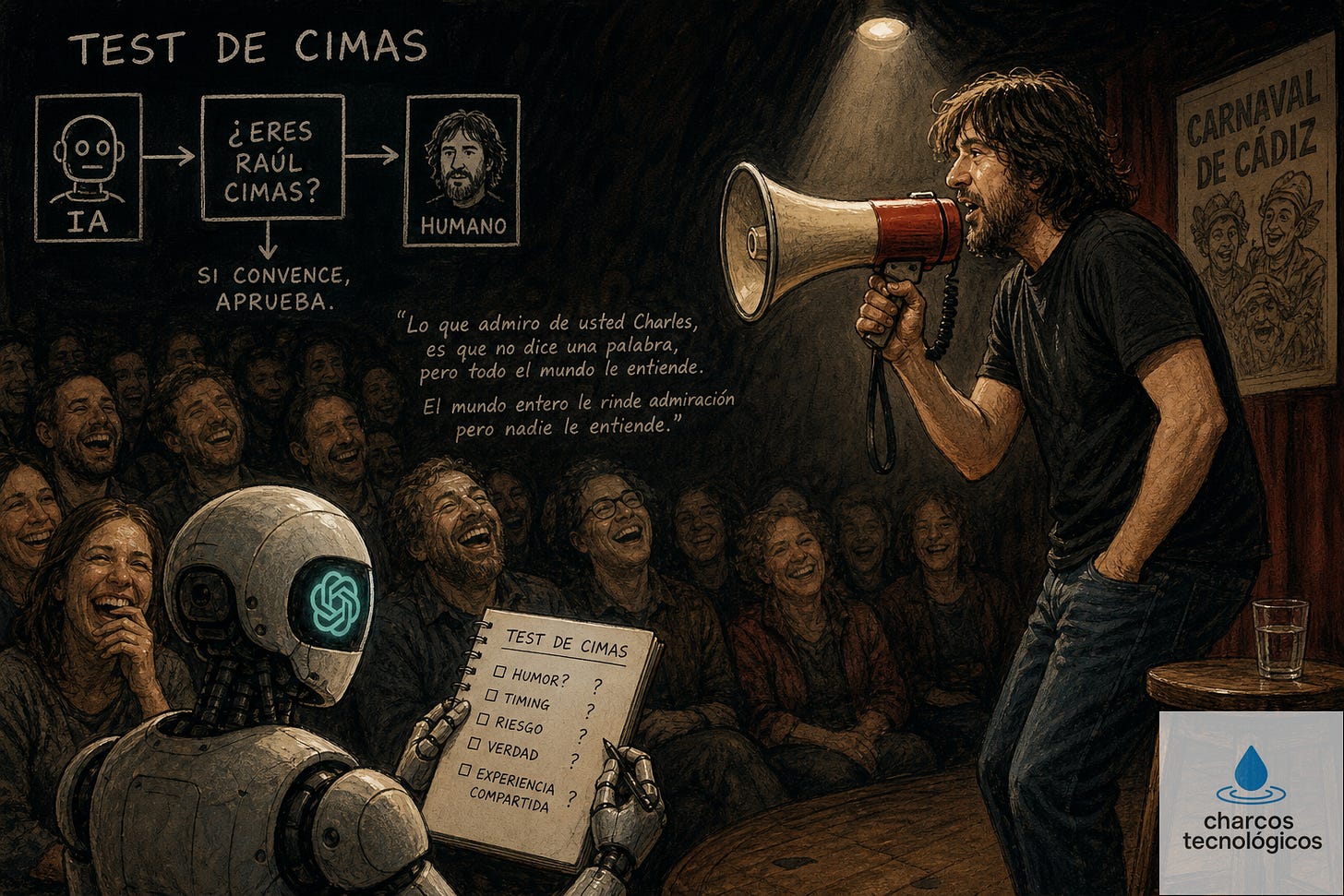
Image generated with ChatGPT.
Some time ago, half jokingly and half seriously, I coined the term “Cimas test” as the heir to the Turing test to distinguish a machine from a person. Currently, AIs are beginning to surpass any variant of the Turing test, at least in its more superficial versions. We therefore need a tool that allows us to discern whether we are dealing with a human or a machine.
And that’s where the Cimas test comes in, named in honor of one of my favorite comedians, Raúl Cimas. The idea is simple: the test measures the ability to produce humor indistinguishable from that of Raúl Cimas, and if it manages to convince us, then it has passed the test. Of course, this raises another problem, which is that perhaps only one person is capable of passing the test, and that is Raúl Cimas (or perhaps Raúl Pérez).
Jokes aside, today I bring up humor because I believe it is not only one of the most genuinely human attributes but also the pinnacle of intelligence. Humor is a complex tool for socialization, self-acceptance, and I would even say survival.
At least in my environment, humor is used, in addition to the obvious, to lighten tense situations, to pave the way for a stranger, to dispel fears, or to evoke past situations in a more gentle manner.
We all know that conversation between Einstein and Chaplin, which masterfully summarizes what humor means:
—What I admire about you, Charles, is that you don’t say a word, but everyone understands you.
—That’s true —replied Chaplin— but your glory is far greater than mine. The whole world admires you, but no one understands you.
Humor is also an instrument of social criticism. The most evolved and refined manifestation of this aspect can be found, as could be expected, in the Carnivals of Cádiz. People, aware of their miseries and misfortunes, laugh at them, not to push them away, but so they do not harm them more than they already do. And from this, they draw a strength that helps them keep walking with their heads held high.
Black humor deserves a separate mention, as it brings before our eyes the darkest parts of our own essence and manages to make us laugh. Not everyone, of course. Which is good news because it highlights our individuality.
To make humor, and to understand it, one must have lived, often one must have suffered, and it is essential to understand the mark that all of this leaves on us. That is something that is only within our reach. In some way, I believe that humor touches the soul because it generates a connection between two consciousnesses, a connection that is only understood if there is a true shared experience.
And yet, not all humor lies in what is said. There is something in the exact moment it is said. A silence that stretches half a second longer than necessary, a phrase that arrives just when the tension begins to be felt. Humor lives there, in that fine adjustment of time that cannot be fully written, only perceived.
There is also an uncomfortable component that we often overlook. Making humor is exposing oneself. It is throwing something out that may not work, that may fall flat, that may not be understood. There is a small chance of failure in every attempt. And yet, we insist. Perhaps because in that risk, there is something profoundly human. I remember once at the Feria de Abril, I was five years old, and they brought me out to tell a joke. I started telling it, and halfway through, I forgot. People laughed (perhaps because I was a child), and I understood that humor is not something perfect, but something that is attempted.
Even if a machine could tell us a joke and make us laugh with it, I suspect it would be missing a part. It’s as if instead of having a conversation between two parties, we had someone with a megaphone who does not expect a response.
Perhaps because humor not only conveys something. It also tests an essential part of ourselves. It allows us to say certain truths without saying them outright, to approach uncomfortable areas without breaking them. It is a way of probing the limit. And I am not sure that a machine can handle that kind of tension.
And only someone like Raúl Cimas shouting to the crowd with a megaphone could ever be funny.